



Planning your whole school year can sound overwhelming, especially when you are already thinking about standards, lesson plans, classroom routines, assessments, school events, and everything else teachers carry before the first day of school.
But here is the good news: you do not need to plan every single lesson for the entire year before school starts.
Instead, you need a flexible roadmap that helps you see where you are going, what you need to teach, and how to stay organized when the school year gets busy.
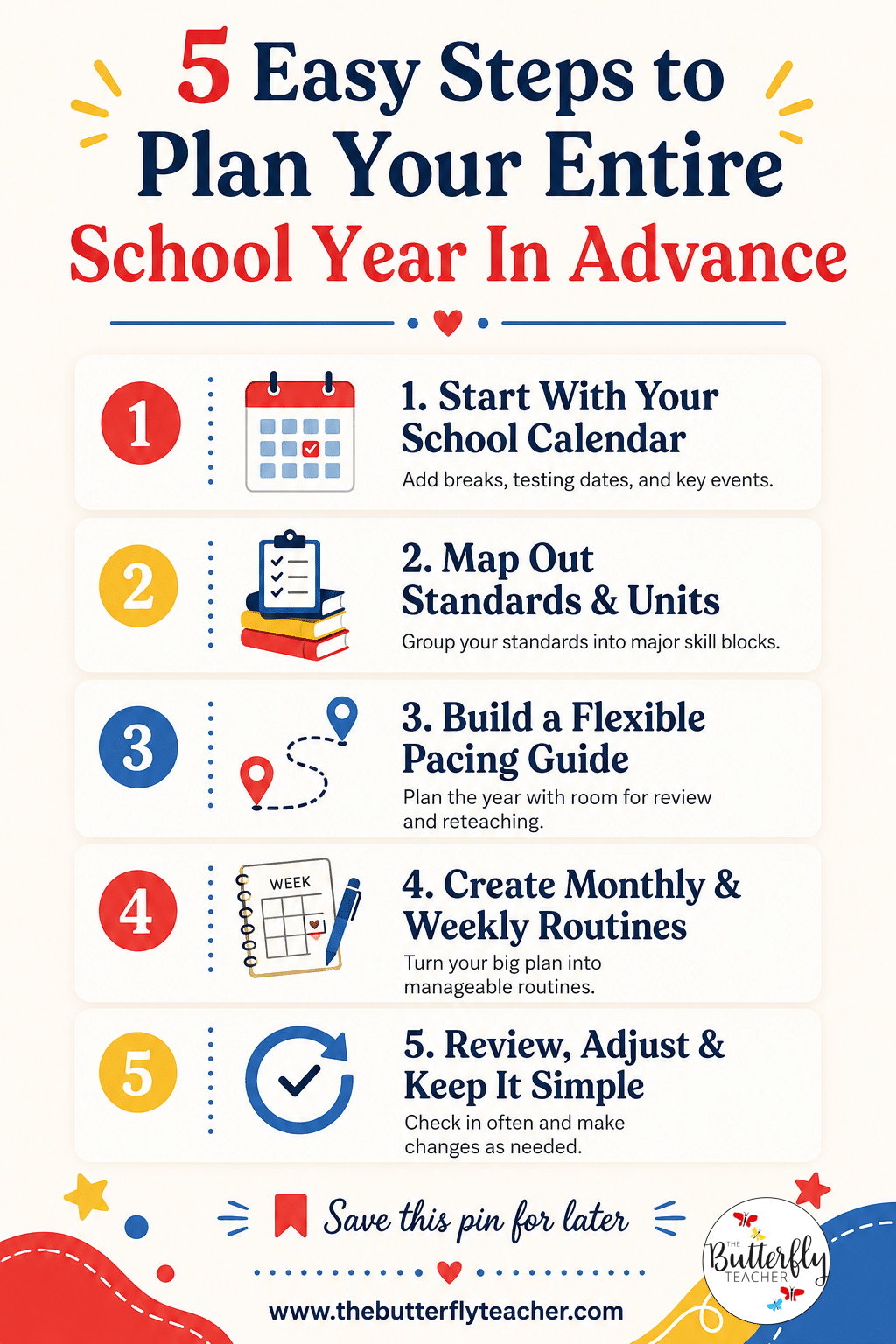
This post shares 5 easy steps to plan your school year in advance without feeling like you have to figure out every tiny detail right now.
This post contains affiliate links to Amazon for your convenience. As an Amazon Associate, I earn from qualifying purchases, which do not cost any extra for you. Please see the full disclosure here.
Can You Really Plan Your Entire School Year in Advance?
Yes, you can plan your entire school year in advance, but that does not mean writing detailed daily lesson plans for every day of the year.
That would make almost any teacher want to close the planner and walk away.
When I talk about school year planning, I mean creating a year at a glance plan that gives you direction. You are mapping out the big pieces first, then using that plan to guide your monthly and weekly lesson planning.
A strong yearly plan can help you answer questions like:
- What standards do I need to teach this year?
- When will I teach each major unit?
- Where do holidays, testing windows, and school events fit?
- How much time should I leave for review and reteaching?
- What routines will help me stay organized each month?
The goal is not to make a perfect plan. The goal is to create a flexible pacing guide that helps you feel prepared without locking yourself into something unrealistic.
Let’s walk through the five steps.
Step 1: Start with Your School Calendar
Before you map out standards, units, or lesson plans, start with your school calendar.
This is one of the easiest school year planning mistakes to make. We get excited about teaching ideas, classroom themes, and new resources, but we forget to look at the actual calendar first.
Then October hits, and suddenly there is a short week, a school assembly, parent conferences, benchmark testing, and a fire drill all packed into the same few days.
That is why your school calendar needs to be the first layer of your yearly plan.
Add the big dates first
Start by writing down the dates that will affect your teaching time. These are your non-negotiables.
- First and last day of school
- Teacher workdays
- School holidays and breaks
- Early release days
- Grading period dates
- Progress report and report card dates
- Parent-teacher conference days
- District testing windows
- State testing windows
- Field trips
- Schoolwide events
- Known assemblies or special programs
Once you add these dates, you will have a much more realistic view of the time you actually have for instruction.
This matters because not every school week is a full teaching week. Some weeks are packed with interruptions. Some weeks are better for review, projects, seasonal activities, assessments, or catching up.
Look for short weeks and busy seasons
After adding the major dates, look at your calendar month by month. Circle or highlight weeks that are shorter than normal or likely to feel extra busy. Go ahead and map these breaks into your teacher lesson planner.
For many teachers, these weeks include:
- The first week of school
- The week before fall break
- The week before winter break
- The week after winter break
- Testing season
- The week before spring break
- The last two weeks of school
These may not be the best weeks to begin a brand-new, heavy unit. They may be better for review, routines, writing projects, centers, seasonal activities, or finishing what you already started.
This one step can save you from building a plan that looks good on paper but feels impossible in real life.
Related Post You May Like ⬇️

Step 2: Map Out Your Standards, Curriculum, and Units
Once you know your school calendar, it is time to look at what you are expected to teach.
This step is where you start building your curriculum map, scope and sequence, or year-at-a-glance plan, if your school doesn’t provide you with one.
Don’t worry if those terms sound a little too formal. We’ll break them down in a simple way.
Start by gathering anything your school or district already gives you.
- Your grade-level standards
- Your district curriculum guide
- Your required textbook or program
- Benchmark assessment dates
- Unit assessment requirements
- District pacing guide, if you have one
- Grade-level team plans from previous years
- State testing blueprints or priority standards
If you are a first-year teacher and your school does not give you much, please know this: you are not the only one.
Many teachers are handed a classroom key, a list of standards, maybe a textbook, and then expected to magically know how to turn all of that into a school year plan.
That is why this step matters so much. Before you can plan your school year, you need to know what you are planning around.
Curriculum Map vs. Pacing Guide: What’s the Difference?
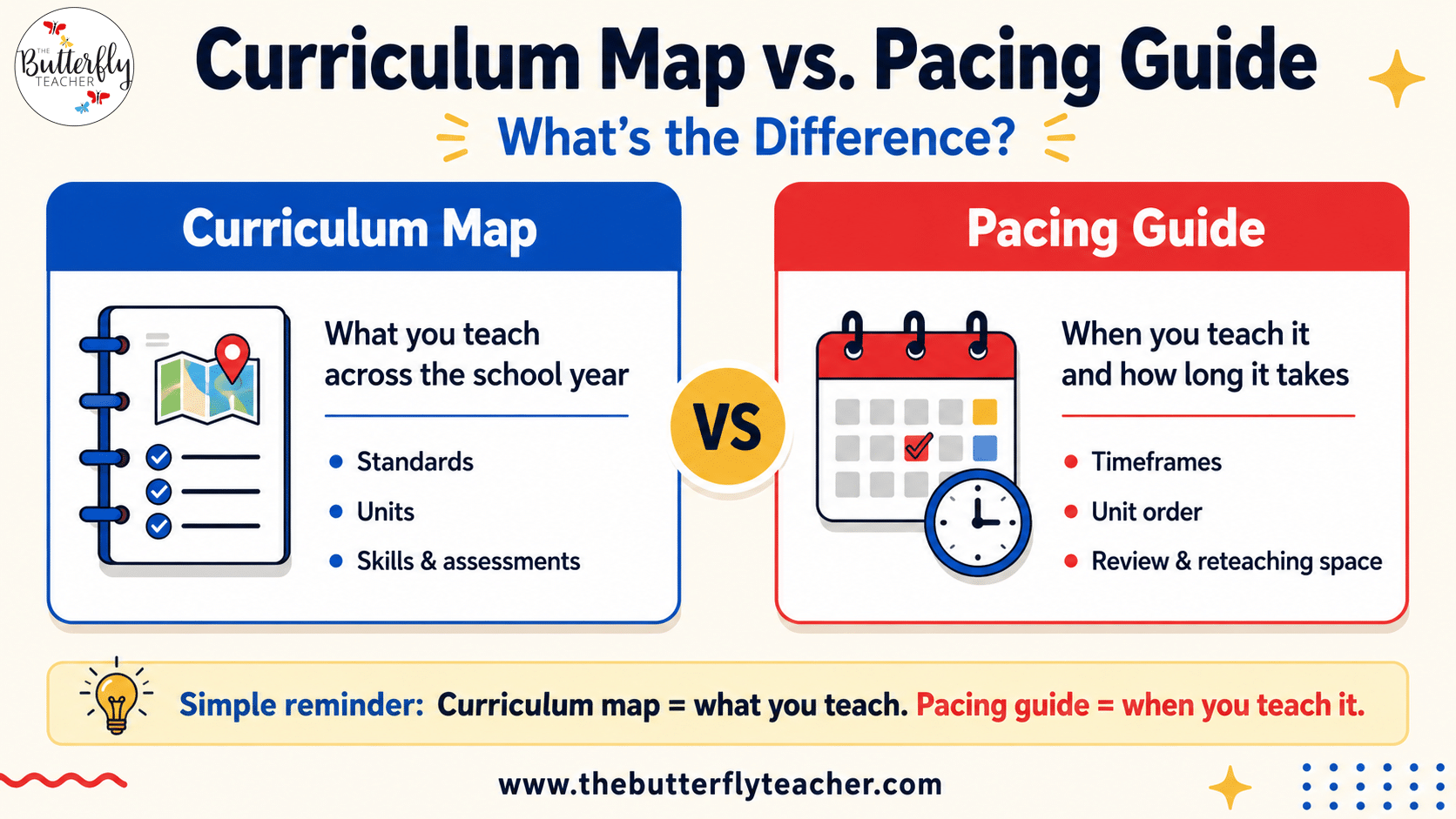
A curriculum map shows what you plan to teach across the school year. It often includes standards, units, skills, assessments, and major resources.
A pacing guide shows when you plan to teach those units or skills and how much time you expect to spend on them.
Here is the simplest way to think about it:
- Curriculum map = what you teach
- Pacing guide = when you teach it
Both can help you organize your year, but they should not make you feel trapped. Even a strong pacing guide needs room for student needs, reteaching, school events, and real-life classroom interruptions.
ASCD describes curriculum mapping as a process that helps teachers organize what is taught, when it is taught, and how learning is assessed. You can read more about curriculum mapping from ASCD here: Getting Results with Curriculum Mapping.
Choose your main units or skill blocks
Now it is time to group your standards into major units or skill blocks.
For example, if you teach upper elementary ELA like I did for several years, your yearly plan may include skill blocks like:
- Reading comprehension strategies
- Vocabulary and word work
- Grammar and language skills
- Writing paragraphs
- Opinion writing
- Informational writing
- Literary analysis
- Test prep and review
If you teach math, your units may include place value, multiplication, fractions, measurement, geometry, data, word problems, and review.
You do not have to list every lesson yet. Just write down the big skills and units that need a place on your year-at-a-glance plan.
Optional: Choose one big teaching focus for the year
This is where I love the idea of choosing a planning theme or teaching focus for the year.
Your teaching focus is not just about cute classroom decor. It is about one area you want to strengthen throughout the year.
Your yearly teaching focus could be:
- Running stronger small groups
- Building better writing routines
- Helping students become more independent
- Strengthening vocabulary instruction
- Improving classroom transitions
- Making centers easier to manage
- Using student data more consistently
- Creating better routines for early finishers
This gives your planning a little more direction. It also helps you decide what to say yes to and what to save for later.
If your focus is small groups, for example, you may choose resources, routines, and learning materials that support that goal all year long.
You do not need a fancy name for your focus. You just need one clear direction that helps you plan with purpose.
Step 3: Build a Flexible Pacing Guide
Now that you know your calendar and your major units, you can start building a flexible pacing guide.
This is the part that helps you plan your school year without trying to squeeze too much into every week.
A helpful pacing guide is not a rigid script. It is a planning tool that shows where each unit may fit across the year.
Edutopia explains that a well-crafted pacing guide can help teachers organize instruction while still leaving room for flexibility and student needs. You can read more about that here: Designing a Well-Crafted Pacing Guide.
Divide your school year into chunks
Start by dividing your year into manageable chunks. You can use months, quarters, trimesters, or grading periods.
Then place your major units where they make the most sense.
For example, your planning chunks may look like this:
| Time of Year | Planning Focus |
|---|---|
| August/September | Routines, review, baseline assessments, first major unit |
| October/November | Core units, seasonal review, writing routines |
| December | Finish units, review, shorter projects |
| January/February | New units, deeper practice, small group support |
| March/April | Review, test prep, reteaching, major assessments |
| May/June | Projects, enrichment, review, end-of-year activities |
Your exact school year may look different, but the idea stays the same. Start with the big picture first. Then you can zoom in later.
Add buffer time before you finalize your plan
This step is so important.
Do not fill every single week with brand-new content.
Leave room for:
- Reteaching
- Review
- Assessments
- Student absences
- School events
- Small group support
- Lessons that take longer than expected
- Extra practice for challenging skills
If you plan every week too tightly, the plan will fall apart as soon as real life happens. Trust me, real life always happens in the classroom. Schedules will change.
You will need longer on a unit than your pacing guide recommends. That’s just how things go in the life of a teacher.
A flexible pacing guide gives you room to adjust without feeling like you are already behind.
Use a “move later” list
As you build your pacing guide, you may notice that you have more ideas than you have time.
That is normal.
Instead of forcing everything into the year, create a “move later” list. This is where you can place extra projects, seasonal activities, read-alouds, enrichment ideas, or lessons that would be nice to include but are not absolutely required.
This keeps your planning realistic while still giving you a place to save ideas you love.
Step 4: Turn Your Yearly Plan into Monthly and Weekly Planning Routines
Once your year-at-a-glance plan is in place, the next step is turning it into a routine you can actually maintain.
This is where many teachers get stuck.
They make a beautiful school year plan in July or August, but by October, they are right back to planning late at night, searching for activities, and wondering what happened.
The yearly plan helps you see the big picture. Your monthly and weekly routines help you use it.
By the way, when you try to wrap your mind around all the holidays and seasons in the year + having activities ready for them, things will get overwhelming fast! That’s why I created this growing holiday learning activities bundle filled with rigorous yet fun supplemental worksheets for my fellow teachers.
Click the image to see how this resource fits with your monthly themes. Besides, this is one less thing for you to have to plan!

Create a monthly planning routine
At the beginning or end of each month, take a few minutes to review your school year plan.
Ask yourself:
| Monthly Planning Check-In | Guiding Question |
|---|---|
| Preview upcoming units or skills | Which lessons or standards are coming up next? |
| Check your school calendar | Are there events, testing dates, breaks, or interruptions to plan around? |
| Review student needs | Which standards need more practice or reteaching? |
| Look ahead at assessments | Are any quizzes, benchmarks, projects, or major tests coming soon? |
| Prep materials early | Which copies, materials, or resources do I need to gather? |
| Simplify where possible | What can I shorten, combine, reuse, or skip this month? |
This monthly check-in keeps your yearly plan from becoming something you only look at once and forget.
Create a weekly lesson planning routine
Your weekly planning routine should connect back to your monthly plan.
Instead of asking, “What am I going to teach next week?” start by asking, “Where am I in the bigger plan?”
Then plan the details:
- Daily lessons
- Small group instruction
- Centers or rotations
- Independent practice
- Review activities
- Assessments
- Early finisher options
- Materials and copies
This helps your lesson planning for the year feel connected instead of random.
It also helps you stop starting from scratch every week.
Plan routines, not just lessons
One of the best ways to make school year planning easier is to plan your routines too.
Think about the parts of your week that repeat over and over again.
- Morning work
- Small groups: for ELA and Math blocks
- Centers
- Spiral review
- Vocabulary practice
- Writing workshop
- Test prep
- Homework
- Friday review
- Early finishers

When these routines are already planned, your weekly lesson planning becomes much easier.
You are not constantly reinventing the wheel. You are plugging the right standards and skills into routines your students already understand.
Step 5: Review, Adjust, and Keep Your School Year Plan Manageable
Your school year plan should be helpful, not heavy.
That means you need to review it, adjust it, and give yourself permission to change it when your students need something different.
This is why I do not recommend treating your yearly plan like a strict contract. Think of it as a living document.
Check your plan each quarter
At the end of each quarter or grading period, review your plan and ask:
| Quarterly Planning Check-In | Guiding Question |
|---|---|
| Review what you finished | Which units, skills, or lessons were completed this quarter? |
| Identify what needs more time | Which concepts still feel rushed, unfinished, or shaky? |
| Look for standards to revisit | Which standards need more review, practice, or reteaching? |
| Move less urgent items later | Which lessons, projects, or activities can shift to another time? |
| Simplify the plan | Which routines, assignments, or activities can be shortened or combined? |
| Stop what is not helping | Which tasks are taking time without helping students grow? |
This is also a great time to look at student data, writing samples, exit tickets, quizzes, classwork, and small group notes.
Your students will show you what needs to happen next.
Collaborate with your team when you can
You do not have to plan the entire school year alone.
If you have a grade-level team, mentor teacher, instructional coach, interventionist, co-teacher, or supportive teacher friend, use that support.
Talk through questions like:
- Which units usually take longer than expected?
- Which standards are the hardest for students?
- What should we review before testing?
- What resources worked well last year?
- What can we plan together to save time?
Even one planning conversation can help you catch things you may not have noticed on your own.
Celebrate progress, not perfection
Planning your school year is not about creating the perfect binder, spreadsheet, or teacher planner layout.
One practical way to celebrate progress is to use a quick Win + Fix + Next Step reflection at the end of each month or quarter.
When I was in the classroom, I had to learn that adjusting my plan did not mean I was behind. Sometimes a writing unit needed more time. Sometimes my students needed extra practice with a skill I thought they already had. Sometimes a school event changed the whole week.
So instead of asking, “Did I follow the plan perfectly?” I started asking better questions:
| Reflection Step | Ask Yourself |
|---|---|
| Win | What worked well for my students this month or quarter? |
| Fix | What needs to be adjusted, simplified, or retaught? |
| Next Step | What is one small change I can make moving forward? |
This keeps your planning realistic. You are not ignoring the plan, and you are not being hard on yourself when things shift. You are using the plan to make better decisions for your students.
That is a win.
Your plan does not have to be perfect to be useful.
School Year Planning Tips for First-Year Teachers
If you are a first-year teacher, planning your entire school year can feel extra overwhelming because everything is new.
You may be learning your curriculum, classroom routines, school expectations, parent communication, grading systems, and classroom management all at the same time.
So please hear me on this: you can plan the whole year in advance without planning every daily lesson before the first day.
Start with these priorities first:
| First-Year Teacher Planning Priority | Why It Matters |
|---|---|
| Start with the school calendar | This helps you see breaks, testing windows, short weeks, and grading periods before you plan units. |
| Plan the first few weeks of routines | Strong routines make the rest of your lesson planning easier. |
| Review required standards | This gives you a clear picture of what students need to learn during the year. |
| Choose your first unit or skill block | Starting with one clear unit helps you avoid planning everything at once. |
| Build a simple weekly planning routine | A repeatable routine keeps you from starting over every Sunday night. |
| Set up classroom management systems | Procedures, transitions, and expectations protect your teaching time. |
| Find your support people | A mentor, teammate, or instructional coach can help you make better planning decisions faster. |
Then build the rest of the year in manageable chunks.
If you are new to teaching, you may also enjoy this post: 20 Insightful and Impactful First Year Teacher Tips.

It gives more practical support for getting organized, managing your classroom, finding help, and giving yourself grace during that first year.
FAQs About Planning Your School Year
How do I plan my school year as a teacher?
Start with your school calendar, then map your standards, units, assessments, and major routines. From there, build a flexible pacing guide with room for review, reteaching, and real classroom interruptions. The goal is a helpful roadmap, not a perfect daily lesson plan for every school day.
Should teachers plan every lesson before school starts?
No. Teachers do not need to plan every lesson before school starts. It is usually better to create a year-at-a-glance plan, organize your units, and plan the first few weeks well. Then you can adjust weekly lessons based on student needs.
What is the difference between a curriculum map and a pacing guide?
A curriculum map shows what you will teach across the year, including standards, units, skills, and assessments. A pacing guide shows when you will teach each unit and how much time you expect to spend on it. Both help you plan with more direction.
How do I create a pacing guide if my school does not give me one?
Start by counting your instructional weeks, then subtract breaks, testing windows, and short weeks. Next, list your major units and divide them across the remaining time. Add buffer weeks for review and reteaching so your pacing guide stays flexible instead of stressful.
How far ahead should teachers lesson plan?
Many teachers plan the whole year at a glance, then plan units a few weeks ahead and daily lessons one week at a time. This gives you direction without forcing you to overplan lessons that may need to change once you meet your students.
How do I keep my school year plan from falling apart?
Build in buffer time from the beginning. Leave space for reteaching, assemblies, testing, absences, and lessons that take longer than expected. Review your plan each month or quarter so you can adjust before you feel behind or overwhelmed.
What should first-year teachers plan first?
First-year teachers should start with classroom routines, the school calendar, required standards, and the first few weeks of lessons. Once those pieces feel clearer, you can build your curriculum map and pacing guide in smaller chunks instead of trying to plan everything at once.
What should I include in a year-at-a-glance teacher plan?
A year-at-a-glance teacher plan should include major units, standards, assessments, grading periods, holidays, testing windows, review time, and flexible buffer weeks. It does not need every daily lesson. It should help you see the big picture before you plan the smaller details.
Ready to Make Your Teacher Planner Actually Work for You?
Once you have your school year plan mapped out, the next step is figuring out how to use your teacher planner in a way that actually helps you stay organized.
Because let’s be honest: a cute planner will not save your school year by itself.
You need a system for using it.
That is why I created a free YouTube playlist all about how to maximize your teacher lesson planner for an organized school year.
In the playlist, I walk through planning ideas like starting with your school calendar, mapping out standards, organizing your yearly plan, and turning that plan into monthly routines you can actually keep up with.
You can watch the playlist here: How to Maximize Your Teacher Lesson Planner for an Organized School Year.
And remember, planning your school year does not have to mean planning every single detail before the first bell rings.
Start with the big picture. Give yourself room to adjust. Then use your plan to make the rest of your teacher planning feel lighter, clearer, and much more manageable.
Happy planning, teacher friend!

4 Responses
Hi Tanya!
I love the idea of planning around a “theme!” I, too, am having difficulty with receiving the guide. I’ve signed up twice and have checked spam. Any help is appreciated! Thanks for your help and for a great article!
Hi Sue,
I’m double checking it for you now. I will email you directly. Please let me know when you’ve received it. Thanks!
Hi,
I love your ideas for planning the whole school year in advance, but I cannot find the planning reflection guide anywhere. I signed up twice, and it is not coming up. Would you be able to send it to me please?
Yes Kathie, I can send it to you directly. But please be sure to check your SPAM folder in case it went there. Also, if you use gmail, the freebie could have gone to your promotions tab. Follow up with me by email here tanya@thebutterflyteacher.com once you have it! Thanks 🙂