



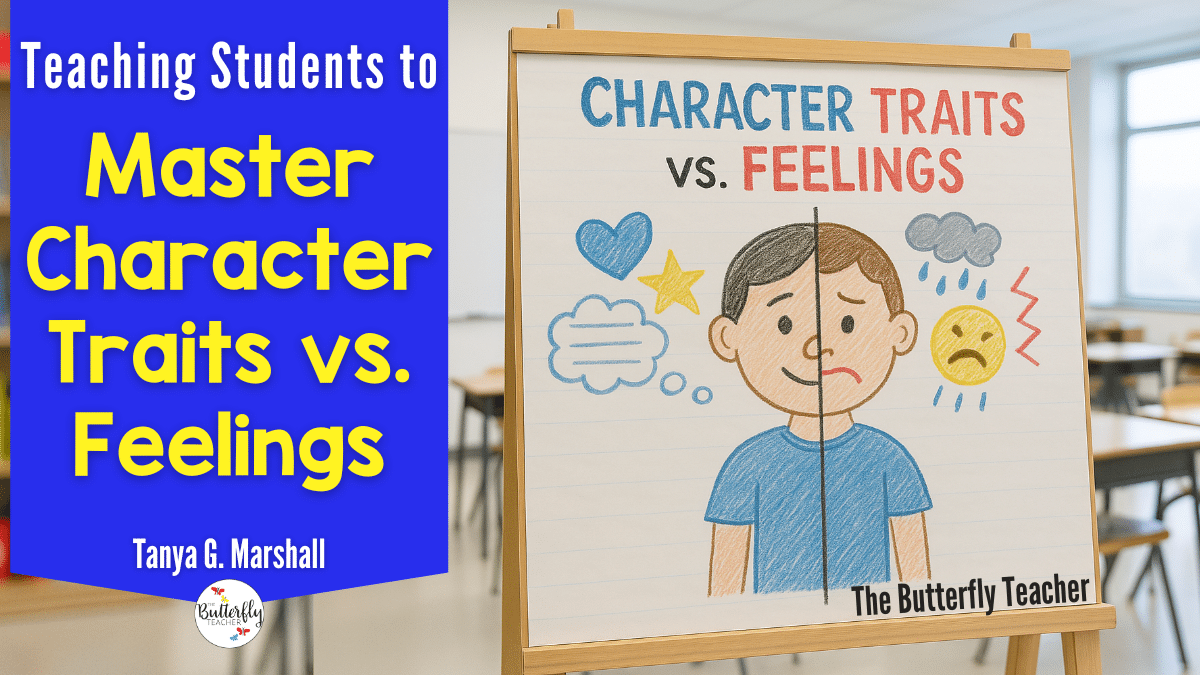
If you’ve ever wondered how to help your students understand the difference between character traits vs. feelings, you’re definitely not alone. This concept trips up so many upper elementary kiddos—especially when both show up in the same story.
Character traits describe who someone is deep down, while feelings describe how someone reacts in a specific moment. But when readers don’t know how to tell them apart, it can lead to shallow reading responses and missed inferences.
This post breaks down why students get confused and gives you practical, engaging ideas to teach character traits vs feelings in a way that actually sticks.
Plus, you can grab some FREE character traits bookmarks below.
This post contains affiliate links to Amazon for your convenience. As an Amazon Associate, I earn from qualifying purchases, which do not cost any extra for you. Please see my full disclosures.
Why Students Struggle with Character Traits vs Feelings
This isn’t just a vocabulary issue—it’s a comprehension skill. When students describe a character as “sad,” they’re often answering based on a single sentence.
But understanding a character trait means looking at what the character says, does, and thinks across a larger chunk of text.
Students struggle with this because:
- Traits require making inferences, while feelings are often stated directly
- They’re used to listing emotions instead of analyzing behavior
- Their character trait vocabulary is limited
This is why it helps your kiddos to directly compare the two side-by-side ⬇️
| Character Traits | Feelings |
|---|---|
| Long-lasting qualities (personality) | Temporary emotions |
| Shown through actions, words, thoughts | Often stated in the text |
| Need to be inferred | Usually obvious |
| Stay mostly consistent throughout a story | Change often, sometimes from page to page |
| Examples: brave, loyal, dishonest | Examples: happy, angry, excited |
Introduce a Character Traits vs. Feelings List to Students
Many students simply don’t know how to go beyond “nice” and “mean.” Teaching a strong set of character traits at the start of the unit sets the stage for deeper analysis. One easy, but impactful way to do this is to give your kids a character traits vs. feelings list.

A simple slideshow or character traits poster with clear definitions for common traits can help. You could also give them a convenient bookmark that divides the two. (FREE set below!)
You can also do the following:
- Use examples from read-alouds to match traits to characters
- Invite students to act out or roleplay different traits
- Create a class anchor chart of “Traits We Notice”
This sets the tone for the rest of your lessons and gives students words they can use in writing and discussion.
Grab these free character traits list bookmarks detailing positive traits for students to learn. Signing up also gets you access to my weekly teacher newsletter packed with more upper elementary teaching tips. 💌
Use Quick Descriptions to Practice Trait Inference
Once students know what the different character traits are, they need a way to practice identifying them. Short character blurbs or mini scenarios work great here. These don’t take much time and still get students thinking.
Try using:
- Task cards with a short paragraph or quote
- A SCOOT game where students rotate and decide the trait being shown
- Think-pair-share discussions: “What do you notice? What trait fits?”
These activities let students flex their inference muscles without diving into a full story just yet.

Add Visual Support with Graphic Organizers
Not every student can make these connections in their head—so visual tools can be a big help.
Use character traits graphic organizers that prompt:
- What did the character say?
- What did the character do?
- What does that tell us about their personality?
Bonus: Introduce trait opposites like brave vs. cowardly or generous vs. selfish. Have students sort characters or scenarios into trait pairs. It deepens understanding and expands vocabulary at the same time.


Use Character Traits vs. Feelings Short Reading Passages
Want to know one of the best ways to help students tell the difference between traits and feelings? Give them exposure to both in a short text and ask them to sort it out.
Use short reading passages followed by:
- Questions like: “Is this describing a trait or a feeling?” “What clues in the passage prove that?”
- Giving an additional prompt: “What in the text helped you decide?”
- A chart where students sort character details into “Traits” vs. “Feelings”
- Writing activities where students create their own characters who show different character traits vs feelings.

These 10 engaging passages help clear up the confusion between character traits vs. feelings while also strengthening reading comprehension. Click the image to see the full set.
These mini-passages are perfect for:
- Morning work
- Small group instruction
- Exit tickets or quick check-ins
They build confidence and boost comprehension—without overwhelming students. Not only that, but they build students’ ability to tell the difference between traits vs. feelings.
Keep It Fun with Character Trait Games
Review and repetition don’t have to feel like a chore. After introducing and practicing different traits, bring in a game to keep the energy up.
A card-matching game where students:
- Match actions to possible traits
- Justify their choices with quick reasoning
- Compete or collaborate with peers
Games like these encourage participation from everyone, including your reluctant readers. They’re easy to use in centers or as a Friday wrap-up activity.

This fun, hands-on character traits matching game can be used for centers or as partner games. It can be found with my full Character Traits Unit. Click the image to see the full set.
Wrap It Up with a Simple Lesson Sequence
Here’s how you might pull these pieces together into a weekly plan:
- Day 1: Introduce character traits using pictures with a detailed slideshow showing characters with their traits
- Day 2: Use task cards to practice sorting and identifying traits
- Day 3: Showcase different character traits vs. feelings with an anchor chart
- Day 4: Use short reading passages for students to sort and explain the difference between the two
- Day 5: Play a review game or create a mini character analysis using graphic organizers
You don’t have to do all this in one week. You can definitely stretch this out depending on how long you want your unit to be.
This lesson sequence just gives you an idea of how this could work in your class. The main point is to choose a flexible format helps students build understanding in small, manageable steps.
Things to Know About Character Traits vs. Feelings
Q–What is the difference between character traits and feelings?
A–Character traits are long-lasting qualities that describe who a character is—like being honest, kind, or stubborn. Feelings are short-term emotions that can change quickly, like being angry, excited, or sad. Traits stay mostly consistent throughout a story, while feelings shift based on what’s happening in the moment.
Q–Can character traits be emotions?
A–No—character traits and emotions are different, even though they’re related. Traits influence how a character responds to situations, while emotions describe how the character feels during those situations. For example, a brave character might still feel scared, but their actions show courage.
Q–How do you infer character traits and feelings?
A–To infer character traits, students look at patterns in what a character says, does, and thinks across the story. Feelings, on the other hand, can often be found directly in the text or inferred from facial expressions and body language.
Helpful strategies include:
- Using graphic organizers to track character behavior
- Looking for repeated actions or choices
- Asking, “Is this how the character feels right now, or who they are as a person?”
Q–What is the difference between personality and feelings?
A–Personality is similar to character traits—it refers to the stable qualities that make up someone’s behavior and mindset. Feelings are temporary emotional states that react to specific events. So, personality stays consistent, while feelings can change based on different situations.
FREE Character Traits List
Teaching the difference between character traits and feelings doesn’t have to be frustrating. With clear examples, scaffolded practice, and just a little creativity, your students can learn to analyze characters with confidence.
Be sure to grab your free bookmarks that list positive vs. negative character traits to the ball rolling on your lesson.

Character Traits Bundle
Want no-prep tools to support everything mentioned in this post? I’ve put together a complete Character Traits Activities Bundle with slides, games, organizers, passages, and more. Click the image to see the full set.
