



Ever taught a grammar lesson on prepositions and thought, “They say these words all day long… so why is this suddenly so hard?” Prepositions seem simple until students have to identify them in actual sentences, explain the object of the preposition, and find the full prepositional phrase. That’s where things can get messy fast. 😅
Prepositions can feel easy at first because students hear and use them naturally. But I bet your kids need more than a quick “under, over, beside” lesson. This post shares ideas, strategies and help for you to teach prepositions easily in your upper elementary classroom.

This post contains affiliate links to Amazon for your convenience. As an Amazon Associate, I earn from qualifying purchases, which do not cost any extra for you. Please see the full disclosures here.
Why Prepositions Need More Than a Quick Definition
You know…prepositions can be sneaky little grammar words. Our students use them all day long, but when it is time to find them in a sentence? Whew. Suddenly those tiny words get tricky!
The biggest challenge is that students are often asked to do more than just spot a word. They need to:
- identify the preposition
- find the object of the preposition
- recognize the full prepositional phrase
- use the phrase correctly in their own writing
That is a much bigger leap than most grammar worksheets make it seem.
When I taught 2nd and 4th grade, I noticed my students could act out “under the desk” or “beside the chair” in two seconds flat. But give them a sentence on paper, and many of them would circle one random word and miss the rest of the phrase completely.That’s why teaching prepositions in upper elementary has to go beyond basic examples.
Start by Teaching What Prepositions Actually Do
If you want to teach prepositions clearly, start with function first. A preposition shows a relationship between a noun or pronoun and another word in the sentence.
I like to explain that prepositions can show:
- Location: under the table
- Direction: toward the door
- Time: after lunch
- Relationship: with my friend
For upper elementary students, I would not stick to only “where” examples. They also need to understand time and relationship examples so they see how prepositions really work in sentences.

A simple anchor chart can help a lot. I’d organize it with these headings:
- Where?
- When?
- Which direction?
- With whom or what?
Then add sentences like these:
- The backpack is under the desk.
- We will meet after recess.
- The dog ran toward the fence.
- She worked with her partner.
This helps students move from memorizing a list to understanding how prepositions work in real sentences. And honestly, that shift matters more than memorizing twenty words just to forget them by Friday.


Move From Prepositions to Prepositional Phrases
Once students understand what prepositions do, the next step is teaching prepositional phrases. This is usually where upper elementary students start to wobble.
A prepositional phrase usually begins with a preposition and includes the object of the preposition. The object is usually a noun or pronoun.
Here’s the simple formula I use:
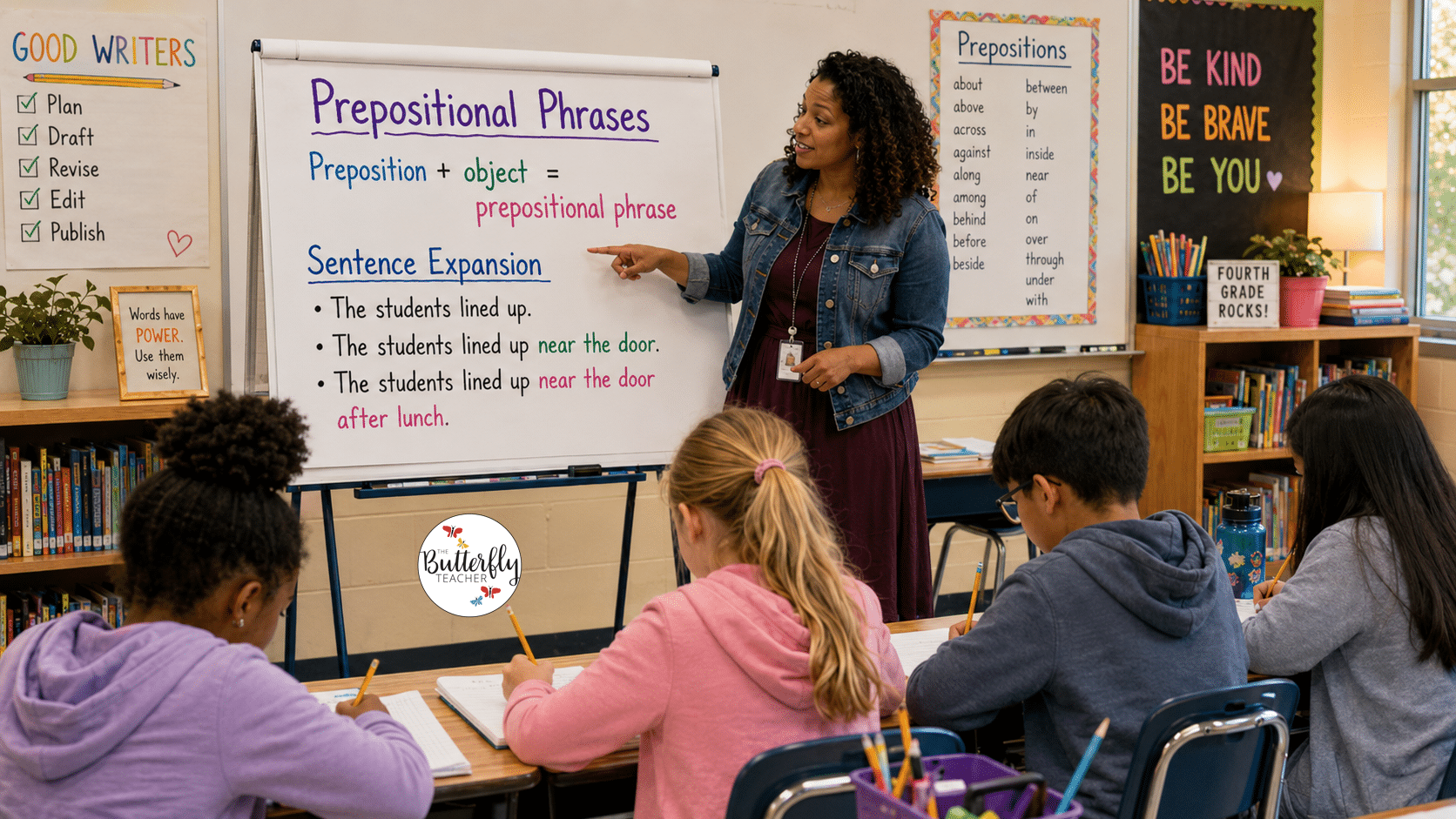
Preposition + object = prepositional phrase
| Phrase | Preposition | Object |
|---|---|---|
| under the desk | under | desk |
| after the game | after | game |
| with my sister | with | siste |
One teacher tip that works really well is this:
- have students underline the full phrase
- have them circle only the preposition
That visual difference helps them stop confusing the single word with the whole phrase.
That repeated practice is where task cards, partner activities, and response sheets can really help. Students need to see prepositions inside phrases again and again before the skill feels automatic.
Use a Quick Video to Review Prepositions and Prepositional Phrases
A short video can be a great review tool, especially for visual and auditory learners. Sometimes students need to hear the same grammar concept explained in a different way before it clicks.
I recommend this one: Prepositional Phrases for Kids | Grammar Lesson.
You can use the video in several simple ways:
- Play it before your mini-lesson.
- Pause after examples and have students identify the preposition.
- Ask students to write one example from the video.
- Use it as a review before task cards or grammar centers.
- Let students watch it again during small group reteaching.
Always preview any video first to make sure it fits your classroom needs and school technology guidelines.
Related Post You Might Like:

Make Prepositions Hands-On Without Making Them Babyish
Yes, upper elementary students still love hands-on grammar practice. The key is making it feel age-appropriate.
Instead of asking students to only act out “over” or “under,” give them tasks that require actual thinking and writing. In my coaching work with teachers, I’ve seen students respond really well when they can manipulate words and then record their thinking.
| Activity | How It Works | Why It Works for Upper Elementary |
|---|---|---|
| Preposition Sort | Students sort cards by location, time, direction, or relationship. | Builds understanding beyond simple memorization. |
| Phrase Builder | Students choose a preposition and add an object to create a phrase. | Helps students practice forming complete prepositional phrases. |
| Sentence Expansion | Students add one or two prepositional phrases to a basic sentence. | Connects grammar to sentence construction and writing. |
Examples:
- beside → beside the window
- during → during the movie
- across → across the playground
Sentence expansion can look like this:
- The cat slept.
- The cat slept under the chair.
- The cat slept under the chair after lunch.
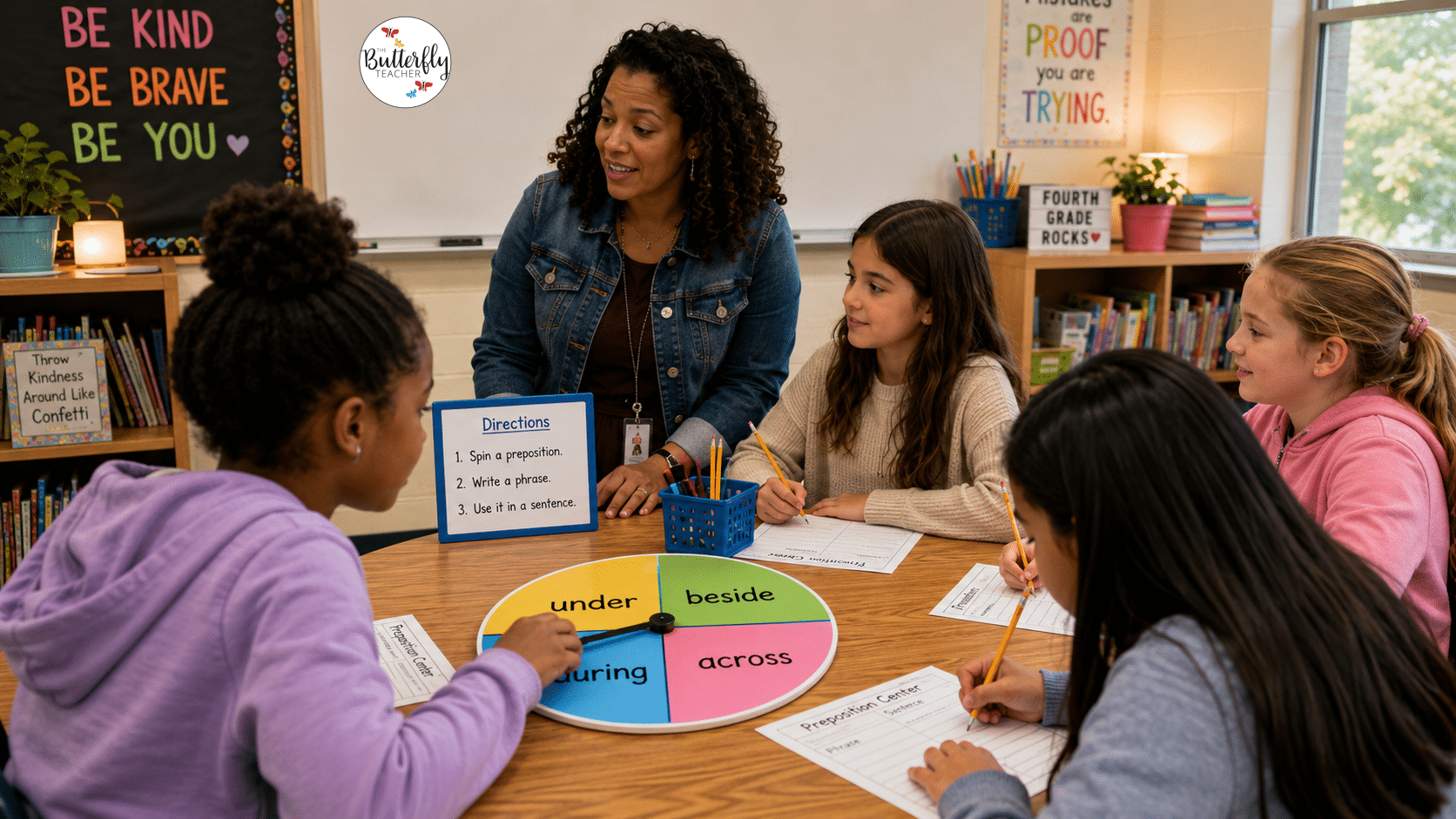
One of my favorite ways to keep preposition practice engaging is with spinners. The spinner format gives students a playful way to generate prepositions, but the recording sheet keeps the activity focused on grammar practice.
Here is the full set of Preposition Spinners Activities
Turn Prepositions Into a Fun Grammar Center
Grammar centers are a great fit for teaching prepositions because students need lots of repeated practice. The trick is giving them a structure that keeps the activity meaningful.
Here’s a simple center routine that works:
- Students spin a preposition.
- They write or say a complete prepositional phrase.
- They use the phrase in a sentence.
- They record their answer.
- Partners check each other’s work.
The spinners add just enough novelty to make grammar practice feel fresh, but students are still doing the important work of identifying and creating prepositional phrases.
My Prepositions and Prepositional Phrases Activity Set includes 6 preposition spinners, student recording sheets, partner work pages, editable templates, and blank templates for extension practice. That means you can use the activity as a grammar center, small group activity, partner game, or quick review.
If you like having both printable and flexible options, this same kind of practice also pairs well with prepositions task cards and digital review on Google Slides.

Connect Prepositional Phrases to Student Writing
Prepositional phrases matter because they help students write with more detail and clarity. They can show where, when, or how something happens, and they can also help students vary sentence structure.
That’s why I never want prepositions to stay trapped inside isolated grammar sentences forever.
Try these simple writing activities:
- Sentence Upgrade: Give students a basic sentence and ask them to add one or two prepositional phrases.
- Writing Hunt: Have students look through their own writing and highlight prepositional phrases.
- Move the Phrase: Let students move a prepositional phrase to the beginning of a sentence.
Remind students that stronger writing is not the same as longer writing. Too many prepositional phrases can crowd a sentence, so the goal is detail that actually helps.
Use Quick Checks to See Who Needs More Practice
Quick assessments are one of the best ways to see whether your students really understand prepositions. This is one of those grammar skills that can look easy during guided practice but fall apart during independent work.
Short checks help you see whether students can:
- identify the preposition
- identify the full phrase
- find the object of the preposition
- use a prepositional phrase in a sentence
| Quick Check | What Students Do | What You Learn |
|---|---|---|
| Exit Ticket | Write one sentence with a prepositional phrase. | Can they apply the skill independently? |
| Partner Check | Trade sentences and underline the phrase. | Can they identify phrases in peer writing? |
| Color Coding | Circle the preposition and box the object. | Do they understand the parts of the phrase? |
| Short Quiz | Identify the phrase in five sentences. | Are they consistent across examples? |
| Writing Check | Add a prepositional phrase to a dull sentence. | Can they use grammar in authentic writing? |
The activity set also includes classwork and homework worksheets, two quiz/assessment worksheets, and a progress monitoring chart, which makes it easier to see who has the skill and who needs another round of practice.
Common Mistakes Students Make With Prepositions
Students tend to make a few predictable mistakes with prepositions, and once you know what to watch for, reteaching gets much easier.
- Mistake 1: Students only identify the preposition.
Fix: Have them underline the full phrase and circle the preposition. - Mistake 2: Students forget the object of the preposition.
Fix: Ask, “Preposition + what?” Example: under what? under the desk. - Mistake 3: Students confuse adverbs and prepositions.
Fix: Show that a preposition has an object. “She went inside.” versus “She went inside the house.” - Mistake 4: Students write phrases but not complete sentences.
Fix: Have them turn every phrase into a full sentence during practice. - Mistake 5: Students overuse prepositional phrases in writing.
Fix: Teach students that phrases should add helpful detail, not clutter.
FAQs About Teaching Prepositions
What is the easiest way to teach prepositions?
Start with simple examples that show relationships between words. Use classroom objects, short sentences, and an anchor chart before moving into prepositional phrases. Students understand the skill better when they see how prepositions work in context instead of memorizing a random word list.
How do you teach prepositional phrases?
Teach the full pattern, not just the first word. I like using the formula “preposition + object = prepositional phrase.” Then I have students circle the preposition, underline the phrase, and name the object so they can see all the parts working together.
What grade do students learn prepositional phrases?
Students are introduced earlier, but 4th and 5th grade are key years for deeper practice. That’s when students are expected to identify, build, and use prepositional phrases in sentences and writing, not just recognize a few common prepositions in isolation.
How do you make prepositions fun for upper elementary students?
Use interactive activities that still feel age-appropriate. Spinners, task cards, sentence building, partner practice, Google Slides, and grammar centers all work well. The best preposition activities balance engagement with accountability, so students are still writing, sorting, and applying the skill.
Why do students struggle with prepositional phrases?
Most students can find the preposition but miss the full phrase. They may also forget the object of the preposition or confuse prepositions with adverbs. Repeated practice with real sentences helps students recognize the whole phrase more automatically.
How do prepositional phrases help student writing?
Prepositional phrases add specific details about where, when, and how. They also help students vary sentence beginnings and create smoother sentence flow. When students apply them in writing, grammar instruction starts to feel useful instead of disconnected from real language.
Keep Preposition Practice Simple and Consistent
Teaching prepositions does not have to be boring or babyish. Upper elementary students just need clear examples, repeated practice, and regular chances to use phrases in sentences.
To keep your teaching sequence effective, focus on:
- mini-lessons that explain what prepositions do
- practice with full prepositional phrases
- quick video review
- hands-on preposition activities
- grammar centers with accountability
- writing connection
- short checks for understanding
If you want a ready-to-use way to practice prepositions and prepositional phrases, my activity set includes spinners, worksheets, recording sheets, partner activities, quizzes, progress monitoring, and Google Slides activities.
This set works well for mini-lessons, small groups, literacy centers, partner work, classwork, and homework. ⬇️

With the right mix of structure and fun, prepositions can become one of those grammar skills your kiddos actually enjoy practicing. 💛
