

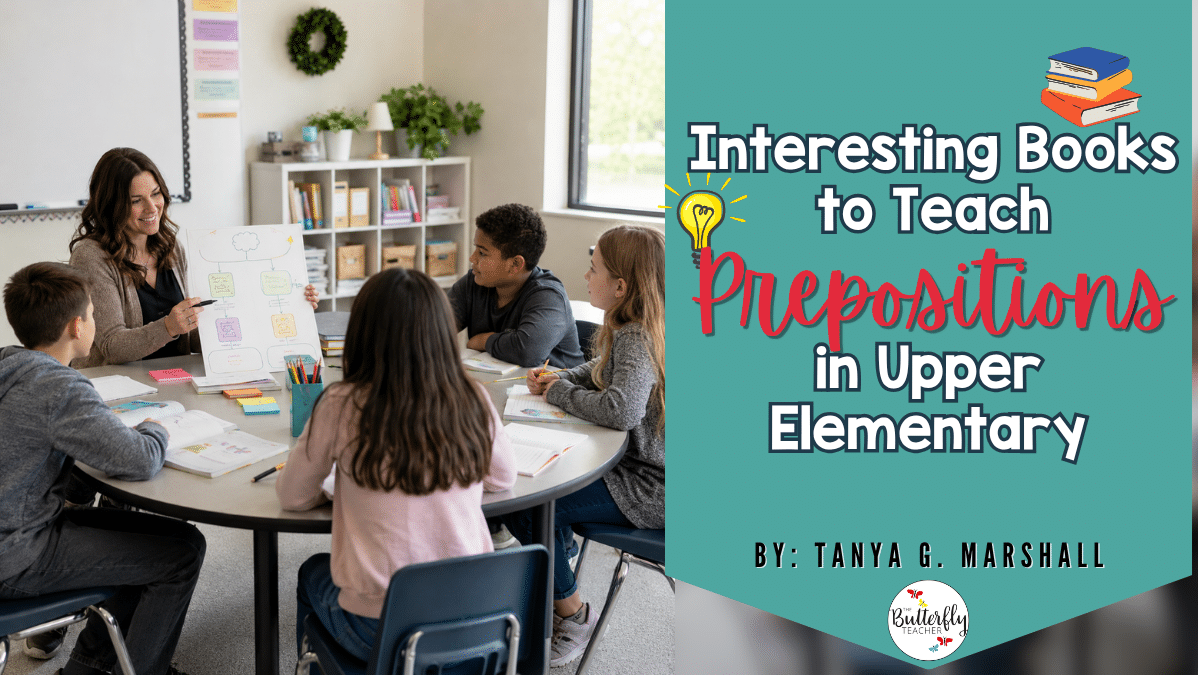
Prepositions may be tiny words, but they can cause big confusion once students start identifying full prepositional phrases.
Most upper elementary students already use prepositions when they talk. They say things like “under the desk,” “after lunch,” or “beside my friend” without thinking twice. But when you ask them to find the preposition, name the object of the preposition, or underline the full phrase, many kiddos need more support.
That is where picture books can help.
The best books to teach prepositions give students clear examples, strong visuals, and sentences they can actually study. They help grammar feel less like a list to memorize and more like a tool students can see inside real writing.
I’m sharing a short list of helpful books to teach prepositions, plus simple ways to use them in mini-lessons, grammar centers, and writing practice. There is also a catchy preposition video at the end that pairs well with these books and gives students extra visual support.
This post contains affiliate links to Amazon for your convenience. As an Amazon Associate, I earn from qualifying purchases, which do not cost any extra for you. Please see the full disclosures here.
📚 How to Choose Preposition Books for Upper Elementary
Many preposition books are written for younger students, so upper elementary teachers need to choose carefully. A book can have cute examples and still feel too simple for 4th and 5th graders. The key is to use the book with a clear grammar purpose.
When choosing books to teach prepositions, look for options that show prepositions in context. Strong illustrations help too, especially when students need to connect words like around, between, across, or beyond to clear visual examples.
You also want books that help students move past single-word answers. In upper elementary, the goal is not just for students to spot “under” or “over.” They should practice identifying:
✅ the preposition
✅ the object of the preposition
✅ the full prepositional phrase
✅ how the phrase adds detail to a sentence
After reading, choose one sentence from the book and model the process. Circle the preposition. Box the object of the preposition. Then underline the full prepositional phrase.
This quick routine helps students see how books to teach prepositions can lead into real grammar practice, sentence writing, partner work, or a quick grammar center.
📖 7 Books to Teach Prepositions in Upper Elementary
You do not need a long stack of grammar books to make this lesson work. A few strong books to teach prepositions can give students clear examples, visual support, and quick sentences to study during your mini-lesson.

Quick note: Some books below also have Kindle versions, which can be handy if you want to preview them fast or project pages during a lesson. Kindle Unlimited may be worth checking too, depending on availability.
Here are some helpful options you can use for prepositions, prepositional phrases, and sentence writing practice.


1. Behind the Mask: A Book About Prepositions by Ruth Heller 🎭
Ruth Heller’s grammar books have a rich visual style that works well for upper elementary students. This book gives you more than simple position words, so it feels like a better fit for 4th and 5th grade grammar review.
As you read, ask students to listen for prepositions and jot down examples. Then choose a few sentences from the book and have students identify the full prepositional phrase, not just the preposition. This helps them slow down and see how the phrase works inside the sentence.


2. Under, Over, by the Clover: What Is a Preposition? by Brian P. Cleary 🍀
This is one of the more playful books to teach prepositions, so it works well when students need a quick grammar warm-up before deeper phrase work. The rhythm keeps the lesson light, but you can still use it for upper elementary practice.
Try a two-column chart while reading:
✅ Preposition only
✅ Full prepositional phrase
As students hear examples, pause and sort them together. This helps students see that one preposition is not the same as the whole phrase.

3. If You Were a Preposition by Nancy Loewen 🧠
This book helps students understand the job of a preposition, not just memorize a list. It works well before a sentence-building lesson because it shows how prepositions connect ideas inside a sentence.
Try this after reading: give students a simple sentence, then ask them to add one prepositional phrase to make it more specific.

4. Prepositions by Ann Heinrichs 📘
This is a clear, straightforward option if you want books to teach prepositions that do not take over the whole lesson. The examples are easy to follow, which makes it useful before students move into independent practice.
Use it for a quick preposition hunt. Students can collect five prepositions from the book, then build each one into a complete prepositional phrase. This keeps the task simple while still pushing students beyond one-word answers.

5. Li’l Pete the Preposition by Grammaropolis 🏙️
This is a strong choice if your students already know a few common prepositions but still need help understanding how they work in a sentence. Since Grammaropolis focuses on parts of speech, this book can fit well into a grammar review week or a quick center rotation.
A helpful follow-up is to ask students, “Preposition plus what?” That simple question pushes them to find the object of the preposition, not just circle the first preposition they see. From there, they can underline the full prepositional phrase in a sentence.

6. Into the Outdoors by Susan Gal 🌲
This book gives prepositions a story setting, which helps grammar feel less isolated. The outdoor theme gives students visual clues for movement, place, and direction, making it one of the more natural books to teach prepositions through context.
After reading, students can write one short outdoor sentence with two prepositional phrases. This works well as a quick writing warm-up before they look for phrases in a paragraph.

7. Around the House, the Fox Chased the Mouse: A Prepositional Tale by Rick Walton 🐭
This book is a fun choice because the title already shows students how a prepositional phrase can move a story forward. It works especially well if you want books to teach prepositions that connect grammar with storytelling.
After reading, let students create a short “prepositional tale” with one character, one action, and three prepositional phrases. They can keep it simple, like:
The cat ran through the kitchen, under the chair, and around the table.
🎶 A Fun Preposition Video to Pair With These Books
After using one of these books to teach prepositions, a quick video can help students hear and see even more examples. One fun option is “Preposition” by The Bazillions.
When I taught 4th grade prepositions, this was one of those songs that stuck with my students, and honestly, with me too! 🙃 The pictures make it easier for kids to visualize the prepositions, and the song is catchy enough to help the words stick.
After watching, ask students to choose three prepositions from the video. Then have them turn each one into a complete prepositional phrase.
This gives students another layer of practice before they start identifying prepositions and prepositional phrases in full sentences.
✏️ What to Do After Reading Preposition Books
Books are a great way to introduce prepositions, but upper elementary students still need repeated practice. After using books to teach prepositions, give students a task that helps them identify the preposition, the object, and the full phrase.
Here are a few simple follow-up ideas:
✅ Go on a preposition hunt in the book
✅ Underline the full prepositional phrase
✅ Expand a short sentence with more detail
✅ Write partner sentences using prepositions
✅ Sort examples into “preposition only” and “prepositional phrase”
✅ Use task cards, spinners, or Google Slides for extra grammar practice


After a read-aloud or video, this is also a great time to move into hands-on grammar practice. A prepositions activity set with spinners, task cards, worksheets, recording sheets, and digital options can help students get repeated practice with prepositions and prepositional phrases.
This works well for literacy centers, partner practice, small groups, or a quick follow-up lesson after using books to teach prepositions.
The best books to teach prepositions can start the lesson, but the real growth happens when students practice using prepositional phrases in their own reading and writing.
❓ FAQs About Books to Teach Prepositions
📚 What are good books to teach prepositions?
Good books to teach prepositions have clear examples, strong visuals, and sentences students can use for quick grammar practice.
🖼️ Can picture books teach prepositions to upper elementary students?
Yes. Picture books work well when you use them as mentor texts. Students can find the preposition, identify the object, and underline the full phrase.
✏️ How do you use books to teach prepositional phrases?
Choose a few sentences from the book. Have students circle the preposition, box the object, and underline the full prepositional phrase.
🧩 What should students do after reading a preposition book?
Students can complete a preposition hunt, expand simple sentences, write partner sentences, or practice with grammar centers.
✅ Are preposition books enough for students to master prepositions?
Not usually. Books to teach prepositions are a helpful starting point, but students still need repeated practice with sentences, task cards, spinners, or quick assessments.
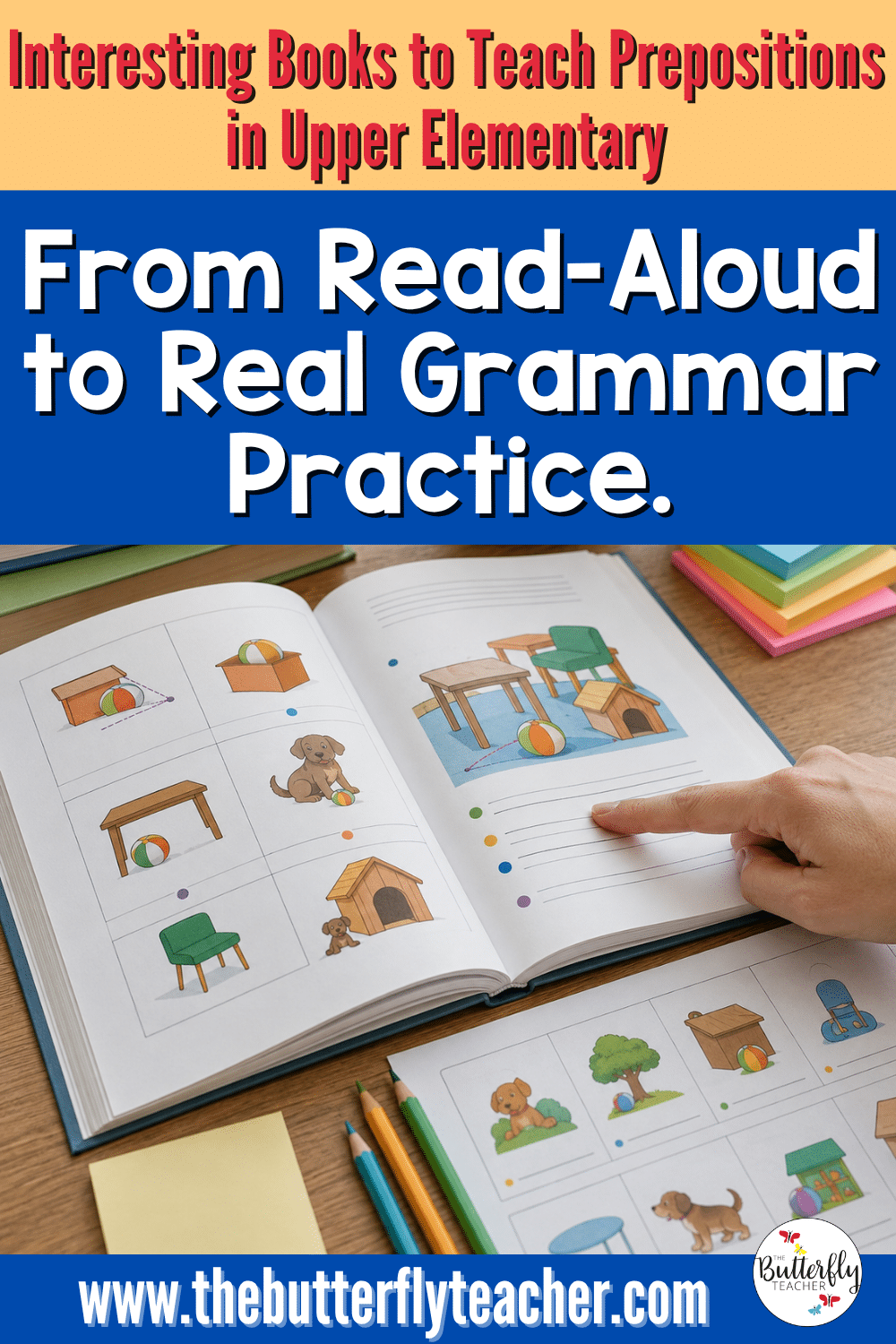
💛 Use Books as a Bridge to Stronger Grammar Practice
Books to teach prepositions can make grammar feel more meaningful because students get to see these words working inside real sentences. Instead of only memorizing a list, upper elementary students can connect prepositions to place, time, direction, and detail.
A good preposition book can introduce the skill, and a catchy video can add a fun review layer. But students still need practice identifying the preposition, finding the object, and using full prepositional phrases in their own writing.
That is where hands-on grammar centers can help. Task cards, spinners, worksheets, and digital activities give students more chances to apply the skill after the read-aloud is over.
Add in a few preposition pictures, a short book, and simple follow-up practice, and prepositions feel a lot less confusing for upper elementary kiddos. 💛
If you have a favorite book, video, or classroom activity for teaching prepositions, share it in the comments. I’d love to hear what has worked with your students!