



Ahhhh….good ole’ early finishers aka fast finishers! 🏃♀️
Every classroom has them. Some students complete work quickly, double-check it (maybe 🙃), and then look up with that familiar expression: “I’m done… now what?”
If we don’t have a clear system in place, that moment can turn into interruptions, off-task behavior, or extra work for us as teachers.
The good news is this: early finisher time does NOT have to mean more grading, more prep, or more stress. With the right organization system, early finisher activities can run smoothly all year long!
In this post, I’m sharing exactly how to organize early finisher activities in a way that builds independence and protects your time.
This post contains affiliate links to Amazon for your convenience. As an Amazon Associate, I earn from qualifying purchases, which do not cost any extra for you. Please see the full disclosure here.
Frequently Asked Questions About Organizing Early Finisher Activities
Let’s kick off with the most essential questions, shall we?
What do you do with early finishers in the classroom?
The key is having a predictable routine.
In my classroom, with procedures training for our routines, my students who finish something early:
- Double-check their original assignment
- Follow a clear “next step” routine that we’ve already practiced and made clear
- Choose from pre-organized early finisher materials at their desks (more on that below)
There’s no wandering around the classroom. No asking me what to do next. No interrupting me.
The secret lies in having an organized system students understand and practice + the kind of activities that keep students busy while still learning.
What do students do when they finish work early?
First, they check their work.
Then, they move to their early finisher system — which might be:
- Completing what’s in their weekly early finisher folder or their “Catch-Up Folder” in case they didn’t get a previous assignment done
- A spiral-bound monthly skills review packet–which is my favorite option!
- Organized task cards they can start working on
The most important part? They already know where materials are and what to do with them.
When teaching, what do you do with kids who finish early while others are still working?
I like to provide a structured, independent early finisher activity or set of independent options that allows me to continue teaching without interruption. Students who are fast finishers need:
- Something quiet, simple and will keep them engaged
- Tasks that allow them to be independent
- Self-directed tasks that do not need to be “taught” or explained.
Activities should NOT require teacher feedback in the moment. If every fast finisher task requires you, it defeats the purpose.
Well-organized early finisher activities allow you to continue small groups or instruction without constant interruption.
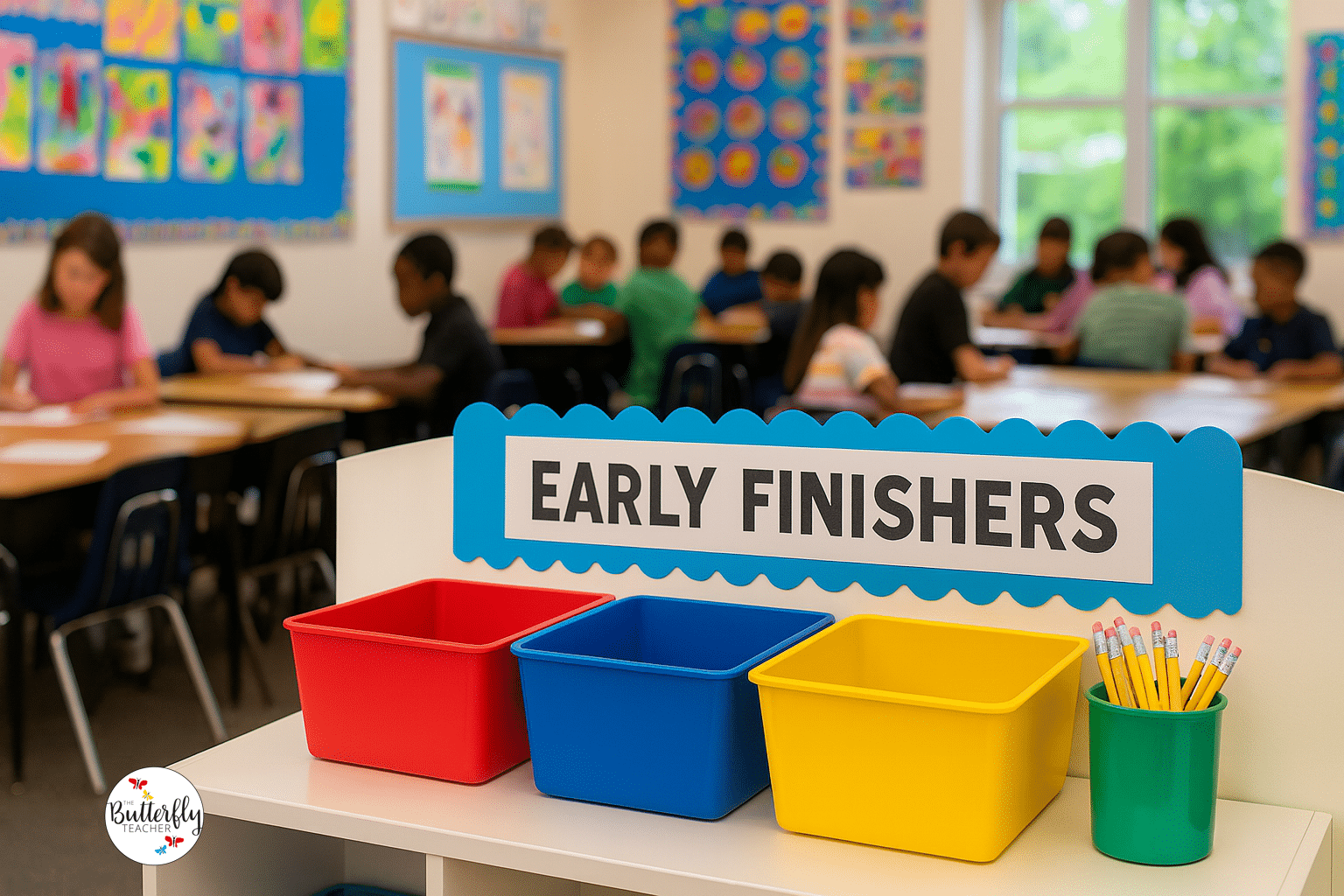
A simple bin system like this allows students to pick up activities (if they don’t already have them at their desks) or turn in their finished work without interrupting you. I usually purchase my bins from Dollar Tree or your can use these from Amazon.
What do you do with early finishers in art or specials?
In art or other specials, choice boards with open-ended prompts work beautifully:
- Sketch challenges
- Creative extensions
- Reflection pages
- Design a collage out of your spelling words (cross-subject connections)
Again, the structure and routine matters more than the activity itself. But you can also use coloring pages, word searches, art history reading comprehension worksheets, or hands-on crafts that are simple to complete independently.
These are just a few ideas to get the ball rolling.

Save this pin to your favorite board.
Please consider following me on Pinterest HERE.
The Key to Managing Early Finisher Activities: A Simple System
Random stacks of worksheets do not equal a system. Nor do you have to only use worksheets. But it does help when you have a clear, steady routine that’s your go-to.
When early finisher materials aren’t organized:
- Students ask constant questions
- Papers and supplies pile up
- You end up grading more than necessary
A simple system (like the one I outline below) :
- Reduces behavior issues
- Builds independence
- Runs like a well-oiled machine after you spend time modeling and explaining what procedures to follow
Let’s walk through easy ways to organize early finisher activities so they practically run themselves.


Easy Ways to Organize Early Finisher Activities
1. Use Weekly Early Finisher Worksheets Folders
If you have ever wondered 🤔:
“Do students turn early finisher worksheets in every day?” or if you are curious about “Do I need to pass out or set up different early finisher activities every day?”
Great questions!
Here’s what works for me:
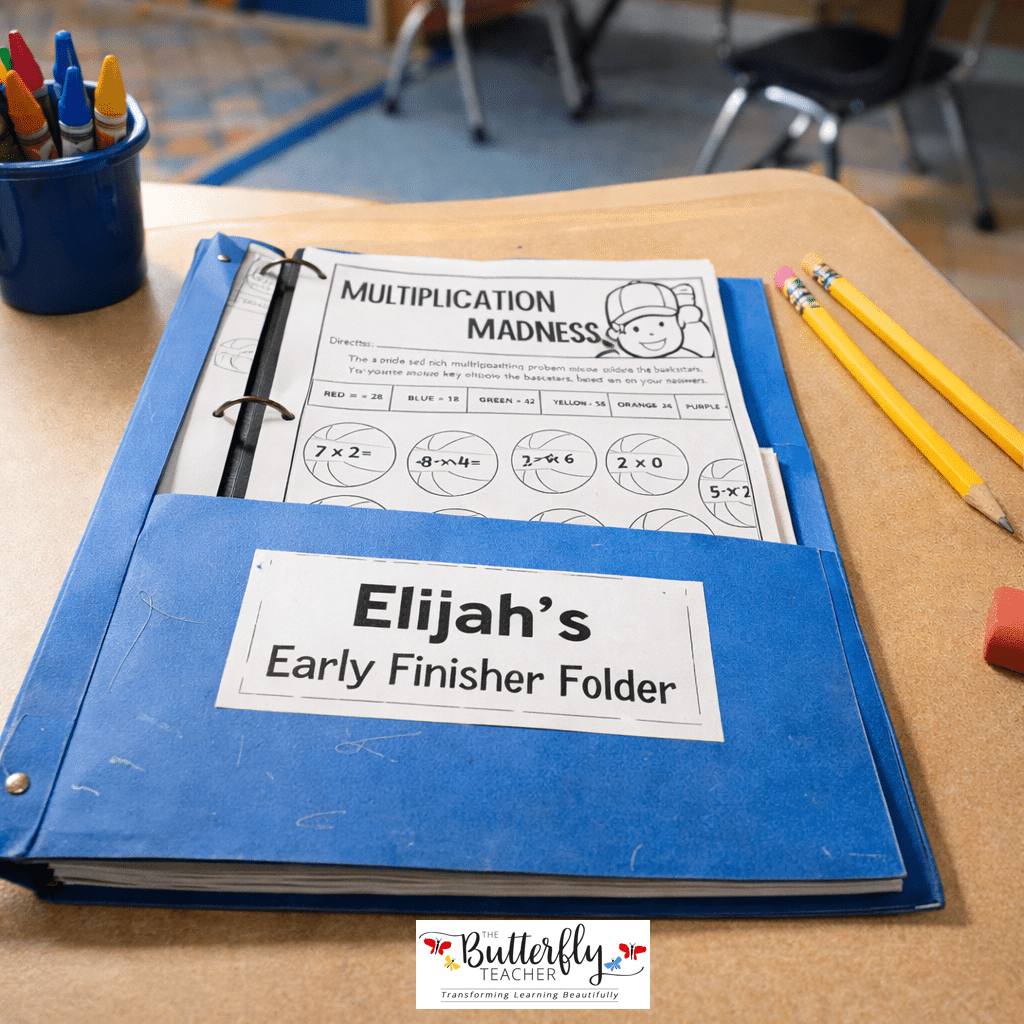
- Students keep their early finisher pages in a designated folder all week.
- The folder stays in their desk or chair pocket.
- On Friday (or you can pick another day of the week), they turn their folder in.
- I (or a room parent or teacher assistant) looks over everything to give completion check or completion / class participation grade for the week.
I don’t grade for accuracy on every page, but that doesn’t mean these are meaningless activities that get thrown in the trash!
If I notice widespread mistakes, that tells me we need to revisit a skill.
That one small organizational shift changes everything.

Click the image to see the full line-up of monthly packets for your fast finishers.
2. Organize Early Finisher Activities by Month
Another game-changer when it comes to fast finisher organization? Monthly packets all ready to go and batched at once.
Instead of pulling random pages each week, I use organized monthly early finisher packets that only need to be printed and spiral bound together.
Here’s how it works:
- Each month has its own set of skills review with Math, ELA, Science and Social Studies + holiday-themed enrichment pages too.
- I either place them in folders OR spiral-bind them using my nifty little book binding machine from Amazon.
- Students keep their spiraled packet / booklet in their desk or chair pocket.
- Anytime they finish early, they pull it out and continue working.
At the end of the week or month, I collect each one for a completion grade and to see how my kiddos are doing with academic skills and concepts.
That’s it.
Everything is in one place — ELA, math, skills review, reading, enrichment — so there’s no extra prep once it’s printed and assembled.
Easy peasy, lemon-squeezy! 🍋
This system also makes organizing early finisher activities incredibly simple to maintain year-round.
How to Organize Task Cards
Task cards are one of my favorite tools for managing early finisher time — but only if they’re organized well.
Without organization, task cards turn into:
- Mixed-up stacks
- Missing cards
- Students asking where to put answers
Here’s what works for me: ⬇️
How I Use Task Cards for Early Finishers (Practical Setup)
- Store task cards in labeled bins, large manilla envelopes or my favorite–photo storage boxes.
- Color-code by subject or skill, which makes differentiation much easier too.
- Have students record answers in a notebook or on a reusable response sheet.
- Do NOT collect daily.
Instead, I do a quick weekly spot-check.
This keeps fast finishers engaged in a way that helps you save time on grading.
Task cards are especially helpful when you want reusable, low-paper options that still feel structured.
Using Early Finisher Packets to Stay Organized All Year
If you want the simplest system possible, organized packets are hard to beat.
My Early Finishers Bundle includes over 175 activities organized by season and month for upper elementary.
Teachers love ❤️ using these in two ways:
Option 1: Monthly Folder System
- Print the month’s activities in advance.
- Place them in a labeled folder.
- Students work through the pages whenever they finish early.
Option 2: Spiral-Bound Packet
- Print the month’s set in advance.
- Spiral-bind it with a book binding machine
- Students keep it at their desk throughout the month.

Both systems:
- Reduce paper clutter because there aren’t a bunch of loose pages everywhere
- Eliminate daily copying, which also means no scrambling at the last minute
- Keep everything contained in one area for your kiddos
And because everything is already organized — ELA, math, review, enrichment — there’s no constant hunting for extra activities.


These fast finisher pages are also available in my TPT store; click either image to see them once you finish enjoying the post. 👍🏾
Why This Early Finisher System Is Perfect for Sub Plans
Let me tell you why this system truly shines.
Two words. Sub plans.
When early finisher activities are already organized, your notes for the sub can simply say:
“Have students complete _____ pages in their early finisher packet if they finish other work early.”
No extra explanation needed.
No additional prep.
No chaos.
Your substitute has structure, and your students stay on routine.
That peace of mind alone is worth setting up your system for how to organize early finisher activities!

Save this pin to your favorite board.
Please consider following me on Pinterest HERE.
Early Finisher Organization Mistakes to Avoid
Even the best activities won’t work without good organization and Plan B thinking. Trust me, teacher friend…you’ll want to avoid these common mistakes:
Offering Too Many Choices
Students feel overwhelmed when there are too many options.
Activities That Require Teacher Help
If every task requires your assistance, students can’t work independently.
No Clear Turn-In System
Students need to know exactly where completed work goes.
Materials Students Can’t Access Independently
If they can’t reach it, they won’t use it.
Grading Everything
Early finisher work does not need to be another stack of detailed grading.
Keep it simple.
Best Early Finisher Activities for Upper Elementary
So, what do you think, teacher friend? Comment below with your thoughts on these ideas for keeping your classroom.
Organization is the foundation.
Activities are the bonus. ✨
I also offer this affordable, year-long bundle of early finisher activities for upper elementary already organized by month. ⬇️

Click the image to see this life-saver resource for your classroom. ✨
A Little Setup Now = A Lot LESS Stress Later
Organizing early finisher activities doesn’t require a complicated system with several different types of activities.
It requires:
- Clear routines
- Contained materials
- Minimal grading
- Independence
Once students understand the structure, early finisher time becomes calm, productive, and predictable.
And teacher friends, that’s the goal.
Here’s to smoother transitions and fewer interruptions in your classroom.
Share this post with a teacher friend who would LOVE these practical ideas. 🦋
