



Have you ever taught context clues, watched your students ace the worksheet, and then noticed they still freeze during actual reading? Teaching context clues often feels harder than we expect because students may know the “school version” of the skill but struggle to use it when they are face-to-face with a complex text.
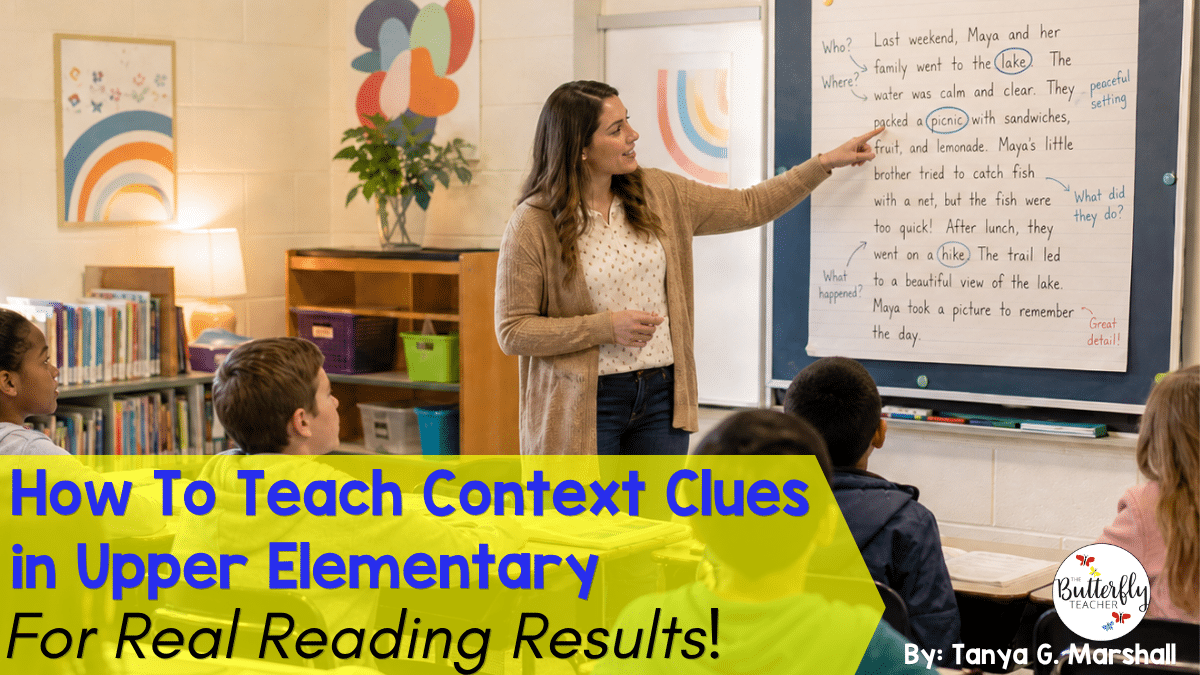
That’s a big deal in upper elementary. As texts get harder, unfamiliar vocabulary shows up everywhere, and one unknown word can throw off comprehension fast. In this post, I’m going to walk you through a simple, step-by-step approach on how to teach context clues so students can use the skill where it really matters—in real reading 📚
This post contains affiliate links to Amazon for your convenience. As an Amazon Associate, I earn from qualifying purchases, which do not cost any extra for you. Please see the full disclosures here.
Why Teaching Context Clues Matters
Teaching context clues matters because upper elementary students are reading more complex texts with more unfamiliar words. If students cannot work through unknown vocabulary, comprehension starts to break down quickly.
Context clues help students make meaning while they read. That matters because this one skill supports:
- Vocabulary growth
- Reading comprehension
- Reading stamina
- Student independence
When I taught 4th grade, I saw this all the time during reading. Students often knew enough to decode the word, but they did not know what it meant in the passage. Context clues gave them a way to keep going without solely depending on me.


Why Context Clues Can Feel So Hard to Teach
Context clues can feel tricky to teach because the thinking is abstract. Students cannot always “see” the strategy the way they can with something more concrete like underlining text evidence or identifying text features.
Here’s why students often struggle:
- They expect the text to hand them the meaning directly
- Real reading does not always include obvious clues
- They guess too quickly and move on
- They are trying to use vocabulary, inference, and comprehension at the same time
That is exactly why explicit modeling matters so much. With teaching upper elementary, I’ve found that students do much better when we demonstrate the skills of how context clues work so that students can use them as one of their reading skills.
What Context Clues Are
Context clues are hints in the sentence, paragraph, or nearby text that help readers figure out the meaning of an unfamiliar word. They are not random guesses.
I always tell students this: Good readers use clues from the text and what they already know. That combination is what makes the strategy work.
So when a student sees an unknown word, the goal is not to blurt out any possible meaning. The goal is to:
- Look closely at the surrounding text or any available pictures
- Notice details that point toward meaning
- Use background knowledge
- Make a thoughtful guess and check it

Step 1: Start With a Clear Purpose
Start by telling students why context clues matter. They need to know this is not just another reading skill to add to the list.
I like to explain it like this: context clues help readers understand what they read without getting stuck on every unfamiliar word. That keeps reading meaningful and engaging instead of frustrating.
You might say:
- “Readers do not always know every word.”
- “Strong readers use the text to help them think.”
- “Context clues help us stay in the reading instead of giving up.”
Step 2: Start With a Mystery Word
One of my favorite ways of introducing context clues is by starting with a mystery or silly word. This makes the lesson feel playful and low-pressure right away 😊
Use a silly or unfamiliar word in a simple sentence, like:
- “The puppy was so flumpish that he kept walking slowly and he could barely keep his eyes open after chasing the ball.”
- “Maria grabbed an orbic, a round toy she could toss back and forth with her brother.”
Then ask:
- What do you think the word means based on the rest of the sentence?
- Which nearby words or pictures helped you?
- Can you use a synonym to replace the word, then read the sentence again?
This is also the perfect time to build an anchor chart from student responses. Let them contribute the thinking they used so they can start seeing patterns.
Step 3: Model the Thinking With a Read-Aloud
Students need to hear exactly what your brain is doing. A read-aloud where you talk about what you’re thinking as you read makes the process visible for your kiddos.
Walk through the process slowly:
- Read the sentence
- Notice the unknown word
- Reread around it
- Look for helpful clues in other sentences or any available pictures
- Make an educated guess based on clues
- Check whether the guess makes sense
You might say something like: ⬇️
“I don’t know the word weary. Let me reread the sentence. It says, ‘After hiking all day, the weary travelers sat down and closed their eyes.’ The words after hiking all day and closed their eyes are clues. I think weary means tired. Let me replace the word “weary” for tired in the sentence to see if it still makes sentence. Yes, that makes sense in the sentence.”
This is the step that makes the strategy less abstract.

Step 4: Teach The Butterfly Teacher’s C.L.U.E. Routine
Students need a repeatable process. That’s where my C.L.U.E. routine comes in.
| C.L.U.E. Step | What Students Do | Why It Helps |
|---|---|---|
| C = Circle the unknown word | Identify the word causing confusion | Keeps students focused on the problem word |
| L = Look around the word | Reread the sentence and nearby text | Helps students search for real text evidence |
| U = Use the clues to make a smart guess | Infer a likely meaning | Moves students from noticing to meaning-making |
| E = Explain why your guess makes sense | Tell which clues support the guess | Prevents random guessing |
I love this routine because it gives students something concrete to do when they get stuck. It turns a fuzzy reading strategy into a clear set of actions.
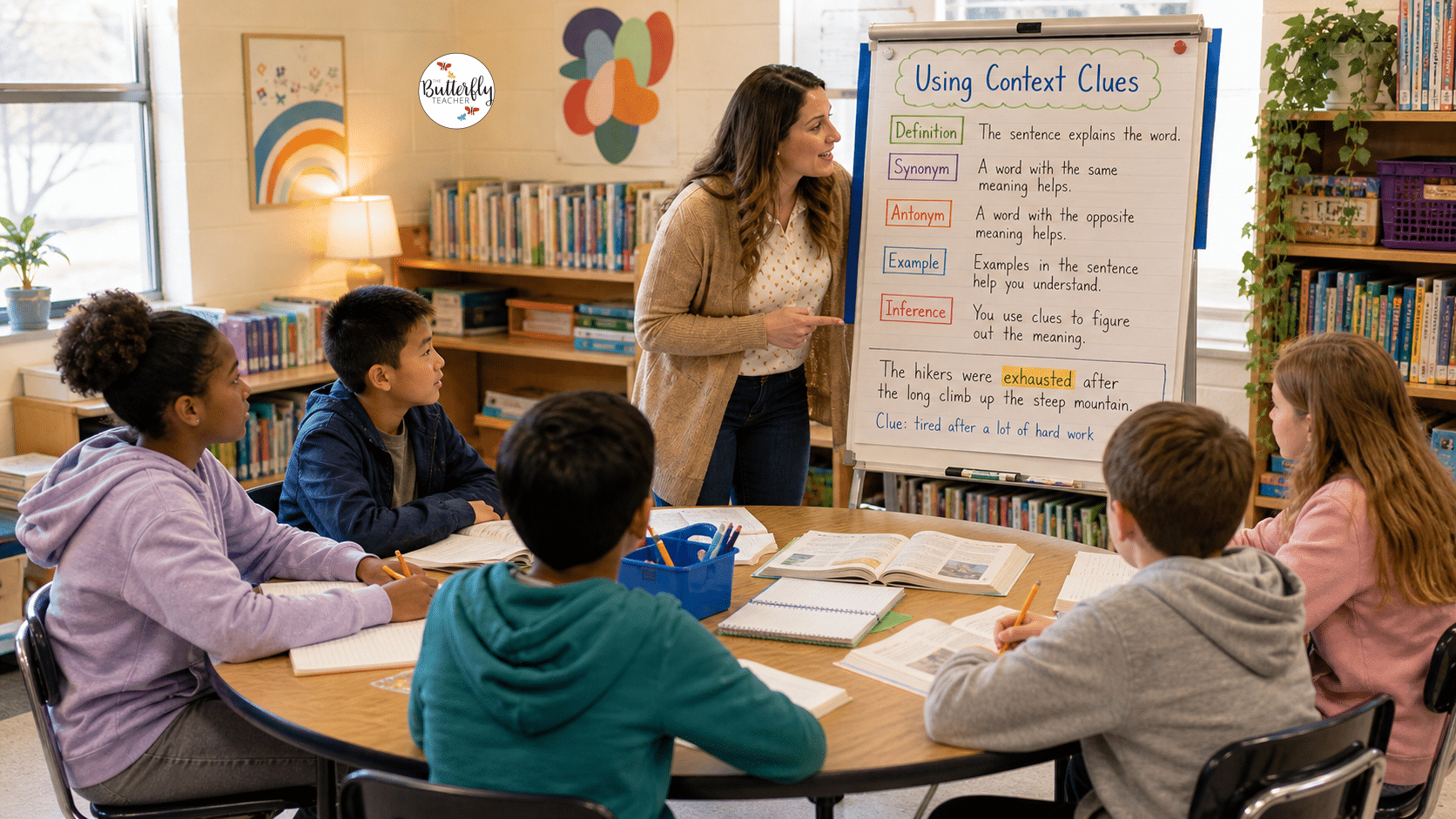
Step 5: Teach the Types of Context Clues Using I.D.E.A.S.
Once students understand the process, you can teach the main types of context clues with the I.D.E.A.S. acronym.
| I.D.E.A.S. Type | Meaning | Simple Explanation |
|---|---|---|
| I = Inference | The reader puts clues together using what you already know + what you see in the text | The meaning is not directly stated, but the text hints at it |
| D = Definition | The meaning is told | The sentence or nearby text explains the word |
| E = Example | Examples help reveal meaning | The text lists examples that point to what the word means |
| A = Antonym | An opposite helps | The text gives a contrast or opposite idea |
| S = Synonym | A similar word helps | The text gives a word or phrase with nearly the same meaning |
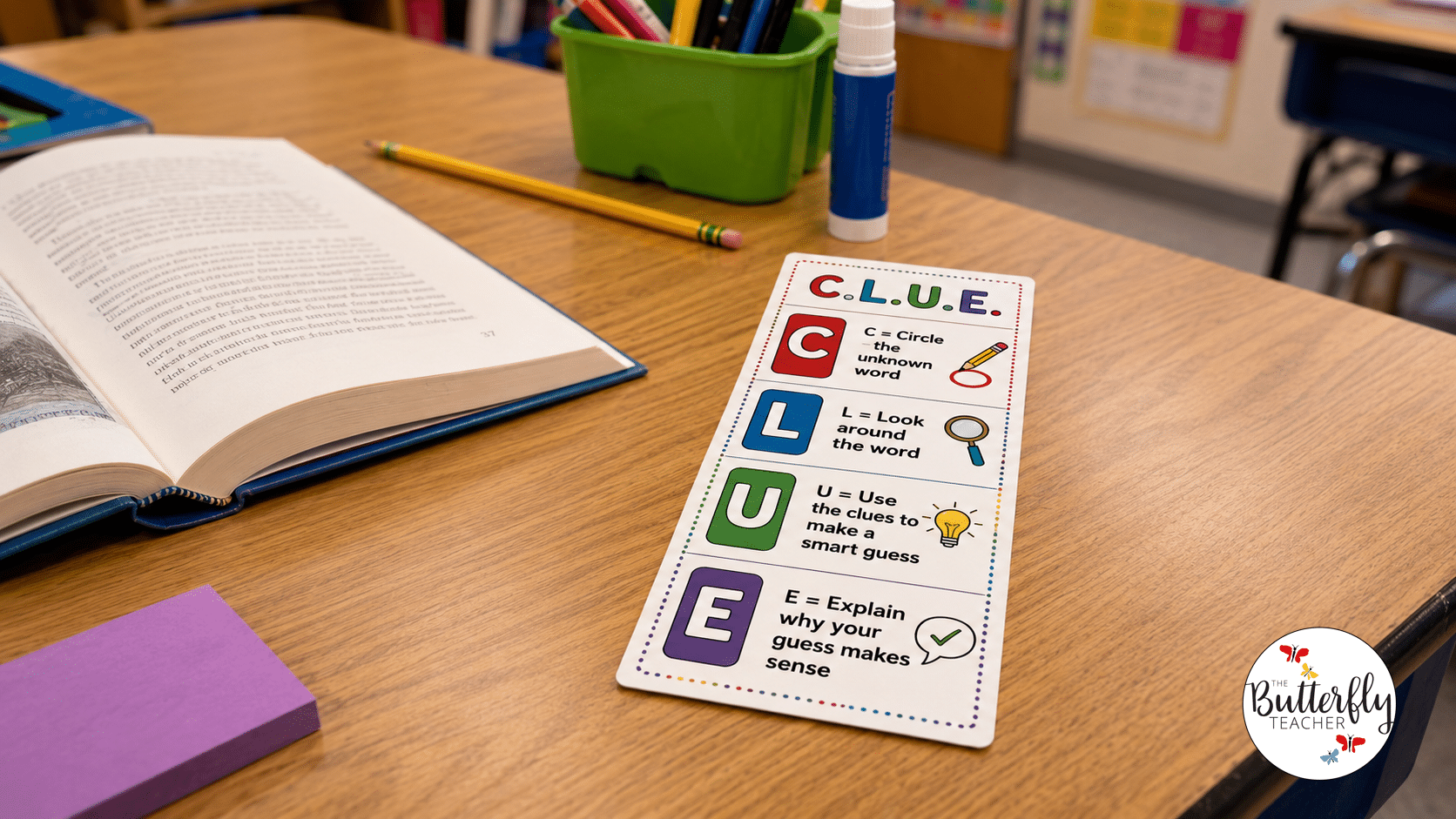
Here’s the simple way to explain it: C.L.U.E. is the process. I.D.E.A.S. is the type of clue students notice.
Keep this kid-friendly. You do not need to overcomplicate the labels at first. Focus on helping your kiddos recognize what kind of support the text is giving them.
Step 6: Practice With Short, Engaging Examples First
Before students apply this skill in lengthy chapter books, let them practice in short, high-interest passages first.
This is where many of the best strategies for teaching context clues begin. Start small so students can be successful.
- Use one strong sentence at a time
- Move into short paragraphs with obvious clues
- Have students use the C.L.U.E. process out loud
- Ask them to identify the I.D.E.A.S. clue type they used
Scaffold generously here. I would not expect independence after one mini-lesson. Students need repeated practice with feedback.


Step 7: Move Into Longer Reading
This is the step that changes everything. Deeper reading results happen when students apply context clues with longer passages, after they’ve practiced on isolated pages.
Scaffold and build up their context clues stamina by bringing the skill into:
- Read-alouds or picture books
- Small-group reading with longer passages
- Chapter books and novels
- Content-area reading like science and social studies passages
When I taught upper elementary, I would often stop briefly during a read-aloud and say, “Let’s use our C.L.U.E. routine here.” Those quick moments showed students that context clues belong in any reading activity.
If you stop at practice pages, students may never transfer the skill to books.
Step 8: Connect Context Clues to Vocabulary Instruction
Context clues work best when they are connected to your broader vocabulary instruction. That is a huge part of teaching vocabulary using context clues effectively.
Use words from the texts you are already reading in class. That way students see vocabulary as part of comprehension, not a separate task.
- Pull key words from read-alouds
- Use content vocabulary from science or social studies
- Ask students to notice unfamiliar words during novel reading
- Practice figuring out meaning before giving a full definition
In my curriculum work now, I always encourage teachers and homeschooling parents to pair vocabulary instruction with other texts and passages. Students remember words better when they meet them in multiple formats.

I included these type of passages and context clues activities in my vocabulary workbook for upper elementary.
Step 9: Teach Students to Check Their Thinking
Students should always check whether their guess actually makes sense. This step is easy to skip, but it is so important.
Teach students to ask:
- Does my guess make sense in the sentence?
- Does it fit the paragraph?
- Does it match what I know about the topic?
Good readers revise their thinking when needed. That’s not failure. That’s smart reading.
Step 10: Layer Other Reading Skills When Context Clues Are Not Enough
Context clues are helpful, but they are not perfect. Sometimes the text is too vague or the clue is misleading. Sometimes students need another reading strategy to add with context clues.
Be explicit about that so students have realistic expectations.
Other helpful supports include:
- Morphology: learning Greek and Latin roots, as well as prefixes and suffixes
- Relying on any visuals that are present
Science of Reading experts agree that his balanced approach matters. One of the most effective strategies to teach context clues is also teaching students when to use something else.


Common Mistakes to Avoid
There are a few common mistakes that can make context clue instruction less effective.
- Teaching context clues only through isolated worksheets–these provide some practice, but don’t stop there
- Expecting mastery after one lesson
- Giving words with weak or unclear surrounding clues
- Treating context clues like random guessing
- Skipping the explanation step
- Not moving the skill into real reading
The goal is not fast answers. The goal is thoughtful reading.
How Context Clues Support Reading Comprehension
Context clues support reading comprehension by helping students unlock unfamiliar vocabulary while reading connected text. When students understand more words, they understand more of the passage.
That said, context clues work best alongside other reading supports, including:
- Decoding
- Morphology
- Comprehension monitoring
- Building Background knowledge
This is especially important in upper elementary, where text complexity increases fast. A student may decode fluently and still struggle to comprehend if too many words remain unknown.
FAQ What does “context clues” mean for students?
Context clues means the hints in a sentence, paragraph, or nearby text that help readers figure out an unfamiliar word. It is not random guessing. Students use what the text says plus what they already know to make a smart, evidence-based guess.
How do you teach context clues step by step?
Teach context clues step by step by starting with a clear purpose, modeling your thinking, and using a simple routine like C.L.U.E. Then introduce the I.D.E.A.S. clue types, practice in short passages, and move into real reading. Explicit modeling is the key.
Why do students struggle with context clues?
Students struggle with context clues because the thinking is abstract and real texts do not always give obvious hints. They also need vocabulary, inference, and comprehension skills working together. Many students need repeated guided practice before the skill sticks.
What are the 5 types of context clues?
The five types of context clues are inference, definition, example, antonym, and synonym. These clue types help students identify how the text is supporting meaning. I like teaching them with the I.D.E.A.S. acronym because it keeps the language simple and memorable.
How do context clues help with vocabulary?
Context clues help with vocabulary by allowing students to figure out unfamiliar words while reading connected text. That builds independence and improves understanding in the moment. Students are more likely to remember word meanings when they learn them in context.
Read-Alouds That Help Teach Context Clues
Hopefully you gained practice tips for teaching context clues so that it doesn’t feel overly complicated 💛 The real goal is not just getting students to name clue types correctly. The real goal is helping them use context clues successfully during any reading activity.
Speaking of, these read-alouds, picture books and chapter books are great to help you teach context clues:

If this helped you think through your own instruction, I’d love for you to leave a comment and share how you teach context clues in your classroom.
