



4th grade literacy centers can be amazing… or a total headache. 🤕 If you’ve ever felt like centers take too much prep, lead to too many interruptions, or end up feeling like busy work, you are definitely not alone. After teaching 4th grade for several years, I learned that literacy centers only work when they are practical, purposeful, and structured enough for students to use independently while you meet with small groups. I saw firsthand how quickly centers could fall apart when they felt too babyish, required constant explaining, or created more work for me than they actually saved.
That’s why I’m so passionate about helping teachers make 4th grade literacy centers work in a real upper elementary classroom today! In this post, I’m sharing what worked for me, what made the biggest difference in keeping centers meaningful and manageable, and how you can use reading centers in your upper elementary class to reinforce comprehension, vocabulary, word work, and writing skills all year long without having to reinvent your whole routine every month. ✨

*This post contains affiliate links to Amazon for your convenience. As an Amazon Associate, I earn from qualifying purchases, which do not cost any extra for you. Please see the full disclosure here.*
Are Literacy Centers Still Worth It in Upper Elementary?
Yes…when they are done with purpose. ✨
I know a lot of teachers wonder if literacy centers are still worth it in 4th grade. And honestly? I get it. Sometimes centers can feel like a lot of work for very little payoff.
If centers are mostly busy work, confusing, or way too baby-ish, then no…they are probably not worth your time.
But when literacy centers are clear, meaningful, and easy for students to complete independently, they can make a huge difference in your reading block.
That is especially true in upper elementary, where scholars still need practice with vocabulary, word work, reading, and writing skills…just in a way that feels more age-respectful.
4th graders are not too old for literacy centers. They just need centers that actually fit their learning needs now.
Why 4th Grade Literacy Centers Sometimes Stop Working
Let’s be real for a second. 😅 Literacy centers usually do not fail because the idea is bad.
They fail because the setup is exhausting.
Sometimes the prep takes forever. Sometimes the directions are not clear enough. Or maybe kids finish too fast and start interrupting your small group. And don’t get me started on the times when the activity just does not feel like a good fit for 4th grade at all. 😵💫
Here are some of the biggest reasons literacy centers can fall apart:
- too much prep to keep up with
- too many interruptions during small groups
- activities that feel more like busy work than real practice
- centers that seem too baby-ish for older students
- no plan for early finishers
- students needing constant help to get started
If you have dealt with any of that, you are definitely not alone. But with the right centers + effective center rotations, you won’t throw in towel on having reading centers in your class.


I dealt with those same issues when I taught 4th grade, which is one of the reasons I designed my literacy / reading centers to solve those problems. I needed activities that were easier to manage, less frustrating to prep, and still meaningful enough to keep my students learning during small-group time.
How to Make 4th Grade Literacy Centers Work Today
Over the years, I learned that 4th grade literacy centers work best when they are simple to manage and meaningful to complete.
As a busy teacher, you do not need a brand-new center for every single week of the school year. Excuse my grammar, but “Ain’t nobody got time for that!” We need center activities that can be used again and again without feeling stale.
That means the best literacy centers usually have a few things in common:
- clear directions students can follow
- repeatable routines
- skills that connect to real literacy instruction
- activities that work with your current curriculum
- built-in options for early finishers
- enough structure for students to stay on task while you teach small groups
That is a huge part of making centers work today. Not making them fancier. Making them more useful. 🙌
That is also why I became so intentional about the way my own 4th grade literacy centers were designed. I wanted activities that could support real reading and word work skills, fit into any ELA block, and keep students engaged without creating more work for the teacher.

Prep once, use all year!
These centers were designed to fill learning gaps, but they also come with built-in early finishers that keep the learning going all year. No switching out centers. And no boredom from your kiddos!
Reading Centers in Upper Elementary Should Not Feel Babyish
This part matters so much.
One of the quickest ways to lose 4th graders during center time is to give them activities that feel too young for them. Older elementary students still enjoy hands-on learning, games, and movement…but they also want work that feels respectful of their age.
That is why I always looked for literacy centers that were interactive without feeling childish and simple to complete without being watered down.
Upper elementary centers should feel engaging, not embarrassing.
They should feel doable, not dull.
When teachers find that sweet spot, students are usually much more willing to stay focused and complete the work.
And honestly, that is one of the things I am most proud of with the centers I created for my own classroom. I wanted them to be easy to use and motivating for 4th graders without crossing into work that felt baby-ish or overly complicated.
What helped me the most was choosing literacy centers that my 4th graders could actually manage and enjoy. Here are a few examples of the kinds of centers I used in my classroom and why they worked so well.
4th Grade Literacy Center for Spelling Practice: Emoji Spelling

One literacy skill that I strive to target through my centers is spelling to help those older kiddos who still struggle with that.
The problem is that spelling practice can feel stale really quickly. If the activity is too repetitive or too boring, students tend to rush through it, tune out, or need more redirection than the center is worth.
That is why I wanted my spelling centers to feel a little more interactive while still being easy to manage during small-group time.
I added a twist to this one by making it “emoji-themed,” which keeps this activity fun for students. Here’s how it works:
- Students write the words with “emoji-code.”
- They switch papers with someone to “crack their code” by writing the spelling words.
I have NEVER had a 4th-grader complain about practicing their spelling words with this literacy center idea!

These 4th Grade literacy activities are available in my store.
Click HERE or click the image to see the full set.
I do not “grade” this worksheet, but I require my students to turn in their literacy centers worksheets for accountability.
Seeing their work also helps me gauge which students are improving their skills through literacy centers practice.
Literacy Work Station Sight Word Practice: Four in a Row
To keep building my students’ reading fluency, I always liked including literacy centers that gave them repeated word practice without making it feel dull.
That is especially important in 4th grade. Some students still need extra support with quick word recognition, and giving them more practice in a hands-on format can make a big difference.

I also needed centers that could be completed independently, in a small group or whole class because sometimes you gotta switch things up.
One of them is the Four in a Row Board Game.
This 4th grade literacy center can be used with a partner, which adds a fun layer of interaction while still keeping the focus on the skill.
- Flip over a sight word card to read out loud.
- If you have the matching word on your board, cover that space.
- The first person to get four words in a row wins that round.
Simple activities like this can be so effective because they give students practice with reading words automatically while still feeling like a game.
I also designed this center to spiral through different levels of sight words, which makes it easier to use with a range of learners.
And because flexibility matters in upper elementary, I wanted centers like this to work for different classroom situations too. Students can use this center with a partner, but it can also support more independent literacy practice depending on how you set up your rotations.
Recognizing words more fluently supports stronger reading comprehension over time. This game gives students a meaningful way to strengthen word identification skills during literacy centers without it feeling repetitive or baby-ish.
This post is also one part of a full series on helpful content geared toward literacy instruction in upper elementary classrooms. Here are the other posts to check out once you’ve read all of this post:
- Why You Need to Have Literacy Centers in Your Upper Elementary Classroom
- How I Use Choice Boards to Run Literacy Centers
- 3rd Grade Literacy Centers*
- 5th Grade Literacy Center Ideas*
- 5 Mistakes You’re Making With Your Literacy Centers (and how to fix them!)
Posts with * beside their titles have free downloads available!
Writing Literacy Center Idea: Spin and Write
Finding time for meaningful writing practice during the school day can be tough. That is one reason I liked including simple writing-based literacy centers in my 4th grade classroom.
When a writing activity feels too complicated, students tend to need a lot more support to get started. But when it is clear, interactive, and focused on one skill at a time, it is much easier for kiddos to work through it more independently.
That is exactly why I liked using Spin and Write.

Since my students loved using spinners just as much as emojis, I used that interest to make sentence writing feel a little more engaging. 🎉
Students use the spinners to land on a wheel with nouns and verbs. Then they write a sentence using one noun and one verb they land on.
It is a simple setup, but it gives students meaningful practice with sentence structure and parts of speech without making the center feel overwhelming.
This writing center also helps me quickly see students’:
- understanding of grammar / parts of speech
- ability to form complete sentences
- subject-verb agreement
- spelling and handwriting
I especially like literacy centers like this because they make it easier to reinforce writing skills during center time while I am still able to meet with a small group.
Literacy Work Station for Root Words, Prefixes, and Suffixes: The Word Maker
Word study is another area I always wanted to make time for in my 4th grade literacy centers, especially because so many upper elementary students still need practice breaking apart and understanding larger words.

Instead of handing students another worksheet on prefixes and suffixes, I wanted them to have a more interactive way to work with word parts and actually see how words are built. That kind of hands-on practice can really help word study click for students. ✨
That is one reason I loved using The Word Maker in my classroom.
This is also one reason I consider centers like this to be Science of Reading-friendly for upper elementary. Working with prefixes, suffixes, and root words gives students meaningful practice with morphology, word analysis, and vocabulary development, which all support stronger reading skills over time.
In this literacy work station, students use root words, prefixes, and suffixes to create and record new words.
This gives them practice with:
- recognizing meaningful word parts
- building vocabulary
- strengthening decoding skills
- understanding how words change when affixes are added
I laminate the triangles so that students can write with dry erase markers. (Instead of the normal sized Expo markers, we use these. They are more colorful and they’re washable.)
I also like this type of center because it keeps the focus on morphology and word analysis–which improves reading comprehension–while still being easy for students to complete more independently.
For 4th grade, that matters so much. Students need literacy centers that feel engaging, but they also need activities that connect to real reading growth.
Centers like this help make word study more meaningful without adding a lot of extra complexity to your reading block.
Do Literacy Centers Support Science of Reading Instruction?
They absolutely can. ✨
A lot of teachers hear “Science of Reading” and immediately think it only applies to primary grades, but that is not really the case. In upper elementary, students still benefit from explicit practice with skills like morphology, vocabulary, decoding, fluency, and comprehension.
That is one reason I wanted my 4th grade literacy centers to support more than just random review. I wanted them to reinforce the kinds of literacy skills that actually help students grow as readers.
The key is making sure the work is purposeful, skill-based, and connected to real reading development.
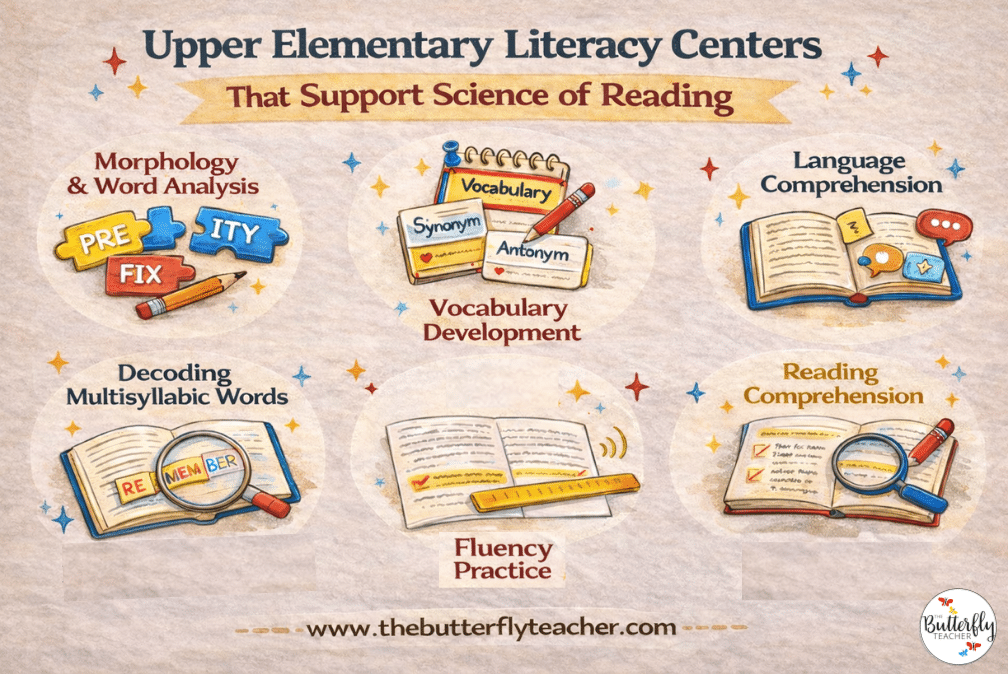
When literacy centers give students meaningful practice with word parts, vocabulary, sentence construction, and reading comprehension, they can fit beautifully into Science of Reading instruction.
That way, centers are not just keeping students busy on fluff while you meet with small groups. 🙌
That is one reason I wanted my centers to support more than just random review. I designed them to reinforce the kinds of skills that actually help students grow as readers and writers.
More Literacy Center Ideas for Fourth Grade
Did you see an idea in this post that caught your attention?
I truly love ❤️ using literacy centers to review and reinforce reading and ELA skills with 4th graders. There are so many ways to make centers meaningful without making them complicated or overwhelming.
And honestly, once you start seeing how well centers can support vocabulary, word study, fluency, and comprehension, it is easy to keep building on them throughout the year.
If you want to see more examples of how literacy centers can work in an upper elementary classroom.
This video shows more details for you: ⬇️
These Grade 4 Centers allows flexibility and differentiation without boring students to tears!
Frequently Asked Questions About 4th Grade Literacy Centers
Do I need to switch out literacy centers every month?
Nope. And honestly, I do not think most teachers have time for that anyway. 😅
One of the biggest mistakes teachers make with literacy centers is thinking they have to constantly prep brand-new activities to keep students interested.
What worked much better for me was using repeatable center formats and changing the words, skills, or focus as needed.
That is one reason I designed my centers the way I did. I wanted activities that could be used all year long instead of becoming one more thing I had to completely redo every few weeks.
What do fast / early finishers do during literacy centers?
This is such an important question because students who finish activities early can turn into interruptions really fast.
The easiest fix is to build in a clear plan before centers ever begin. That might look like:
- extension activities that students complete with each center (like the ones I have here)
- bonus tasks
- extra word work that builds on the center activity
- vocabulary add-ons
- a reading response follow-up
You could also have meaningful early finisher activities that compliment your centers ready in a no-prep packet or in a bin. Then train your kiddos to grab those once they finish their centers.
I always found that centers ran much more smoothly when students already knew what to do next without needing to ask me during small-group time. This is such a heavy-hitter topic, that I have way more detailed info about how I deal with early finishers in both of these posts ⬇️:


How do I keep students from interrupting my small group?
A lot of this comes down to routines and training students on the procedures of center time.
If students are interrupting constantly, it usually means one of three things is happening:
- the directions are not clear enough
- the task is too hard to complete independently (or too easy so they’re bored)
- students do not yet have the stamina or routines for center time
That is why I always recommend teaching and modeling each center in detail before expecting students to use it on their own. This may takes weeks for them to master, but once you have the routine in place, things run like a well-oiled machine from there!
Clear expectations, simple directions, and repeatable routines make a huge difference. Once students know what the center should look and sound like, interruptions usually decrease a lot.
Can literacy centers support small-group reading instruction?
Absolutely. In fact, that is one of the biggest reasons I used them.
Literacy centers gave the rest of my class something purposeful to work on while I met with a small group. The key was making sure the center work was clear enough for students to complete independently and meaningful enough that it did not turn into boring busy work.
When that happens, centers stop feeling like chaos and start becoming a real support during your reading block. 🙌
How many literacy centers should I have at one time?
The exact number really depends on how much time you have in your literacy block and how many students are in your class.
If you only have a short amount of time for center rotations, you may only need 2 or 3 strong center options running at once. But if your literacy block is longer and you are rotating several groups, you may want a few more.
Class size matters too. A smaller class can usually function well with fewer center choices, while a larger class may need more stations or more copies of the same type of activity to keep things running smoothly.
That is why I do not think there is one magic number that works for every teacher. What matters more is choosing a number of centers that your students can manage well and that fits the time you actually have.
If you want me to walk you through that step by step, I break it all down in this YouTube video, including how to think through your schedule, class size, and center rotations in a practical way.
Should 4th grade literacy centers be independent or partner-based?
Honestly, both can work.
Some literacy centers are great for independent practice, especially when students need quiet accountability. Others work really well with a partner when the activity includes discussion, games, or shared review.
The biggest question is not whether the center is independent or partner-based. It is whether students can complete it successfully without pulling you away from your small group every five minutes.
That is the standard I always came back to in my own classroom.
How Long Should Centers Be in 4th Grade?
Planning literacy centers for upper elementary really does start with one big question:
How much time do you actually have?
And today, that answer looks very different from classroom to classroom.
Some of my fellow 4th grade teachers are self-contained and have the same group of kids all day. Others are like me and are departmentalized; so we see students for a shorter class period, then rotate.
And many teachers are working with tight schedules that only allow 20–30 minutes for center time.
So instead of focusing on one “perfect” number of minutes, I always recommend starting with your real schedule and building from there. (Don’t forget to include transition time!)
I taught 4th grade language arts and social studies, and I shared students with another teacher who taught math and science. That meant my literacy block was a full 90-minute class period, but I did not run centers every single day.

“Sentence Wars” has been renamed.
These year-long literacy activities help 4th graders with several ELA skills.
Click HERE or click the image for the full set.
Most weeks, I used literacy centers two or three days a week, depending on what we were working on and how much instructional time we needed.
When I had that full block, my sweet spot looked like this:
- About 25 minutes per center
- 3 center rotations
- A few minutes for transitions and clean-up
But I also had years when my schedule looked very different.
One year, all I had was a 45-minute literacy block, so my students completed:
- Two 15-minute literacy activities
- About 10 minutes for transitions and prep
And that worked just fine.
Today, I know many teachers are working with even less time, sometimes just 25–30 minutes total. In those situations, it is completely okay to:
- run one strong center
- rotate centers across different days
- use centers only a few times per week
- keep activities short and focused
Literacy centers do not have to happen every day to be effective.
What matters most is that the time you do have is used for meaningful practice that students can manage independently while you teach.
Planning Your 4th Grade Stations
As you plan out how long your centers should be for 4th grade, keep these things in mind:
- Amount of total students you have
- How long your students need to transition (the more you model and prepare them for centers, the less transition time they need)
- Whether you’re going to use fixed groups or choice boards to manage your centers.
And when it comes to the question of how to make 4th grade literacy centers truly work in your class, I also strongly recommend having student-friendly instructions included. The ones I have here ⬇️ include a picture of the activity set-up and in use + an “I Can” standards-aligned statement + simple instructions.

Why so many details? Because when (not if) students “forget” how to complete an activity, the one-page guide is right there in front of them.
No need for you to re-teach anything. This helps your kiddos to be independent during center time.
Not only will the answers to these areas help you map out the time-frame for your stations, but it will make center planning in general easier.
“How Do You Organize Literacy Centers?” More F.A.Q’s
I get so many questions about how I set up literacy centers in my classroom. Here are a few of the main ones that were not answered above:
Are you self-contained with your centers?
No, as mentioned above, I only teach Language Arts & Social Studies and I have a co-teacher who teaches Math & Science. We share the same full class of 4th graders, but we each have our “homeroom” group. Our students switch classes, and our classrooms are right across the hall from each other.
How many students are in each group when you run your 4th grade centers?
I do not allow more than 4 students per literacy center. In fact, all of the centers mentioned above really only allow 2 or 3 students working on that center at a time.
So how do you “group” your students for center rotations?
I start off the year by assigning fixed groups of 3-4 students and I MODEL behavior and procedures like crazy! But then I train my students to choose their own centers using Choice Boards. I have an entire detailed post on how I use choice boards HERE.
Do you have fixed stations?
My classroom layout isn’t big enough for literacy centers to be in the same spot, so I only use centers that students can grab and move around the room to different locations. This also helps control the number of kids completing each center.
The only literacy center that stays put is my Technology Center where I have 4 desktop computers. Our school has one iPad cart for all the 3rd-5th grade teachers to share, and I also keep this center stationary so that I can keep a close eye on my students while they’re using the iPads.
A Detailed Guide Book for Planning Your 4th Grade Literacy Centers
Although the questions and answers above give a glimpse into how I set up and run literacy centers in my class, they are just scratching the surface!
There are so many details to keep in mind.
I wrote a quick guide with detailed answers to these questions PLUS literacy center planning pages for teachers.

Click the image to grab your guide!
This guide walks you through setting up centers and details this info:
- How to choose “groups” for your centers?
- A breakdown of different time frames and what to do for your literacy block during those time frames.
- Details on the best ways to differentiate your centers.
- Knowing whether to switch out your centers each week or not.
- Options on how to help students choose a center OR setting up fixed student groups.
- AND MORE!!
I know how overwhelming it can be to get centers going in the classroom when you have a million other things to consider and do as a teacher!
Hopefully the ideas and info from this post can get the ball rolling for you.
The series of posts listed at the top also have ideas and tips for literacy centers.
As an added bonus, the blog post below (in the image) tells you everything you need to know if you’re new to teaching 4th grade.

Literacy centers can still work beautifully in 4th grade. The key is making sure they are purposeful, manageable, and meaningful for upper elementary students.
You do not need a perfect schedule, a huge literacy block of time, or brand-new activities every week to make centers effective. You just need a plan that fits your students, your time, and the skills you want your scholars to practice.
I hope these ideas helped you see that reading centers can support real growth while also allowing your ELA block to run more smoothly. ✨
If you want literacy centers that are easy to use, engaging for older students, and flexible enough to use all year long, be sure to check out my 4th Grade Literacy Centers resource shown below.
And of course, 🗣️ comment below with your thoughts on running centers in your classroom.


Click here for the full set that is ready for you to use anytime of the year!
3 Responses
Thank you for the insight, great read indeed! I will be using these activities in my class.
That’s great to hear Caroline! Thanks for stopping by.
This was a great read and thank you for sharing! Looking forward to using the activities in my class.