



Whether you’re Irish or not, bringing St. Patrick’s Day into your classroom activities is so much fun! This post shares engaging St. Patrick’s Day activities for upper elementary.

*This post contains affiliate links to Amazon for your convenience. As an Amazon Associate, I earn from qualifying purchases, which do not cost any extra for you. Please see the full disclosure here.
Table of Contents
St. Patrick’s Day for Your Classroom


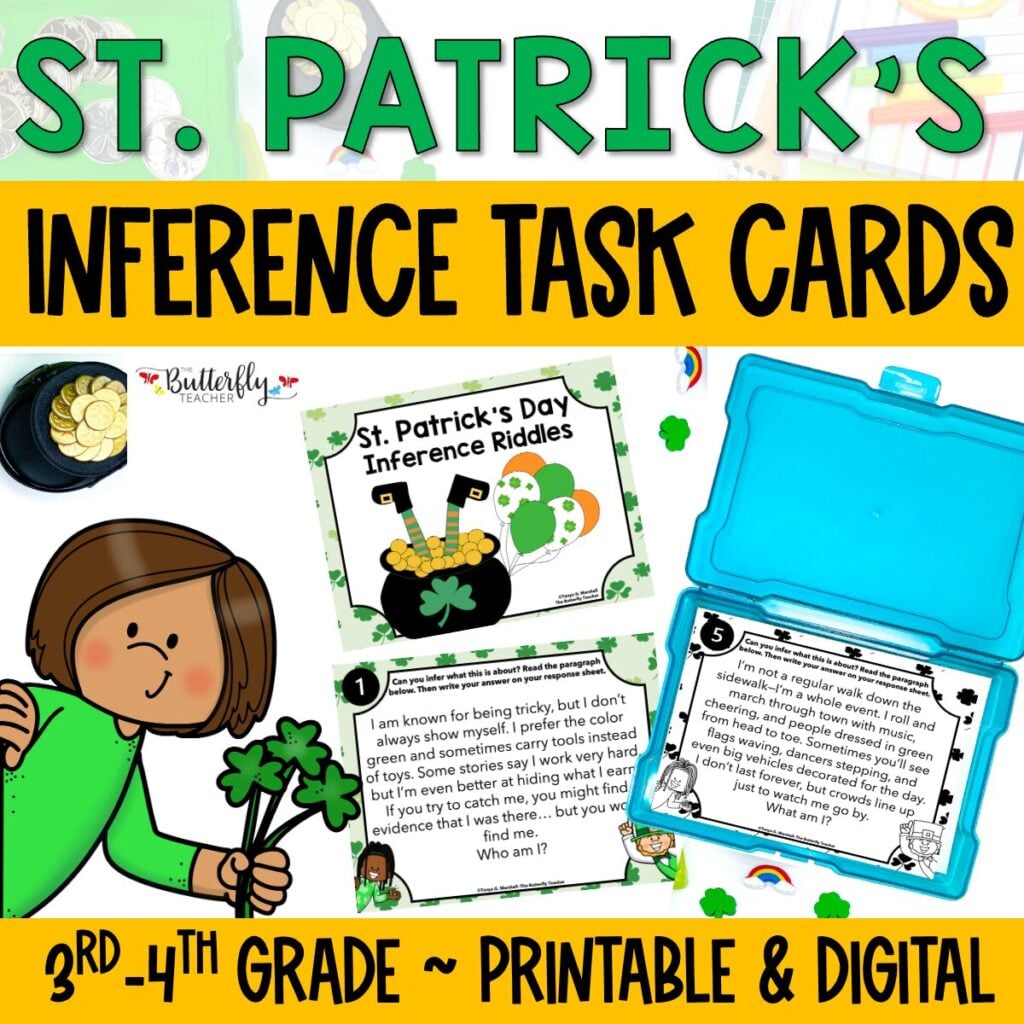
Click any image to check out these fun St. Patrick’s Day and March activities you can use in your classroom!
St. Patrick’s Day Read-Alouds for Upper Elementary
Let’s jump right into these St. Patrick’s Day activities with some book ideas for 3rd-5th grade students.
Even though some of the book ideas shown have reading levels outside of 3rd-5th grade levels, they can be combined with other rigorous St. Patrick’s Day activities for your students.
My favorite one to read is Fiona’s Luck by Teresa Bateman.

The “Character Wheel” shown in this picture is a part of my Character Education resource.
Click the image for more details.
Fiona is a clever girl who finds a way to trick leprechauns into sharing their “luck” with everyone who is struggling to survive in Ireland.
I use this St. Patrick’s day book to analyze the main character Fiona and highlight different character traits to describe her.
It’s also a great book to introduce the concepts of “luck” vs. “hard work.” Students need to know how their actions impact results, rather than just having good luck!
This book offers a fun way to have a class discussion about it.
How to Catch a Leprechaun St. Patrick’s Day Activity
Another really fun St. Patrick’s Day book idea is from the author Adam Wallace titled How to Catch a Leprechaun.

The theme of this book matches the title exactly! Two kids are trying to catch a leprechaun that’s doing mischievous things around their home.
I try to connect this read-aloud with this fun leprechaun writing center where students have to write a “How to…” paper on catching leprechauns.
My co-teacher who does Math & Science (I teach ELA & Social Studies) uses this same read-aloud for a “How to Catch a Leprechaun STEM project.”
These are always really fun St. Patrick’s Day activities for our upper elementary students!
There Was An Old Lady Who Swallowed a Clover
I love the entire series about the old lady who swallowed a bunch of stuff!
So this one by Lucille Colandro definitely makes the list for our St. Patrick’s Day books.
These books are excellent mentor texts for teaching sequence plus cause and effect.

Each time the lady swallows something, it’s because she has a goal for the previous items she swallowed.
So not only do I challenge students to keep the correct order of items, but they have to explain why she swallowed them in that particular order.
Even though these books seem silly and fun with their rhyming words, they work really well to develop reading comprehension skills.
Plus, I combine this with nonfiction St. Patrick’s Day activities about clovers.
Jamie O’Rouke and The Big Potato
It’s hard to have St. Patrick’s Day activities without mentioning Ireland or leprechauns. So this read-aloud by Tomie dePaola fits really well with this holiday.
It’s about a lazy Irish man named Jamie who becomes desperate to get help with growing potatoes. This is where the leprechaun enters the story! I can’t tell the rest, otherwise, I’ll give away the story. 😉

Since it’s an Irish Folktale, students have to find the bigger meaning that connects to real life. And I LOVE when children’s literature connects to moral lessons that can be applied in real life.
St. Patrick’s Day Activities : Fun Mystery Pictures
March is a busy time of the year with testing, spring break, and so much more. Having fully no-prep options can be a huge time saver. Instead of having to print and pass out, you just click then assign!
So here are some engaging St. Patrick’s Day activities that work well for digital learning:
St. Patrick’s Day Mystery Pictures Activity
This resource is a Google Slides set that tells the history of Saint Patrick and how St. Patrick’s Day started.
Once students read the informational text passages, they must answer comprehension questions that allow them to “solve” the mystery picture.
Not only did I include reading passages, but also math practice that can be related to St. Patrick’s Day.
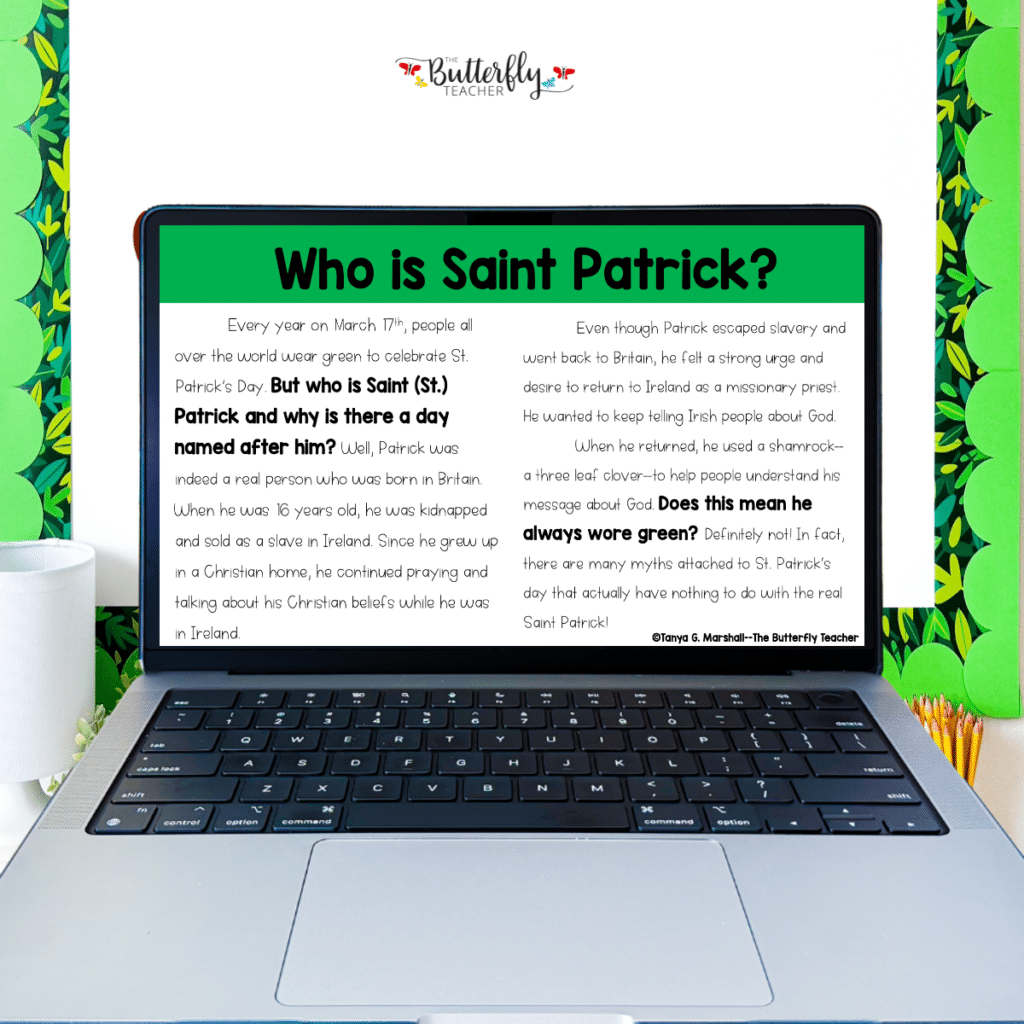

Click either image to use this fun mystery pictures reading activity with your kiddos!
This activity can easily be connected with other nonfiction reading material for St. Patrick’s Day, or you can pair this with any of the read-aloud book options mentioned above.
Use These High-Interest March Close Read Passages
Although St. Patrick’s Day is a lot of fun, it’s still only one day. So I am connecting it with other high interest Spring topics that will extend throughout March.
That’s why these digital March Informational Text passages include topics like:
- Clovers
- Rainbows–with some “facts” about leprechauns of course
- Thunder
- Caterpillar & Butterflies
- Tornadoes and more…

These informational text passages and questions come in a Google Slides AND printable format.
Click the image to get them for your classroom.
Since several of these topics are woven into most of our St. Patrick’s Day read-alouds, upper elementary students are more interested in learning the facts about them.
This is also a great way to compare and contrast fiction with nonfiction.
How Can I Make St. Patrick’s Day Writing Activities Meaningful in Upper Elementary?
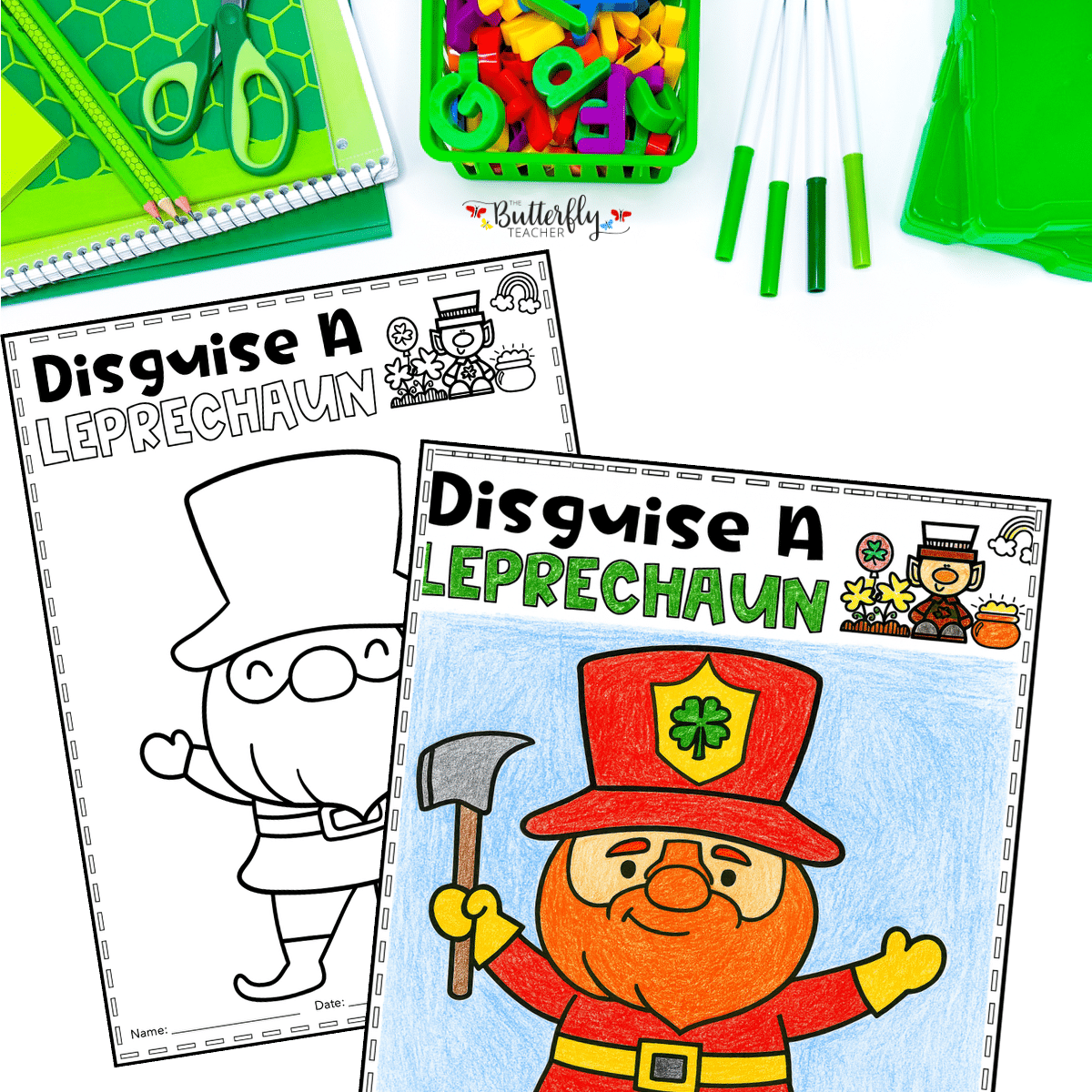
🍀 Disguise a Leprechaun Creative Writing Activity
Teacher friends, if you’ve ever done a “disguise” project in March, you already know the excitement level is HIGH. But in upper elementary, we need more than cute — we need purposeful writing practice.
This is where a Disguise a Leprechaun writing activity really shines.
Instead of simply decorating a leprechaun, students:
- ✏️ Create a brand-new identity for him
- 🧠 Develop a believable backstory
- 💬 Use descriptive language to make the disguise convincing
- 📢 Persuade the reader that he is not a leprechaun
Now we’re talking about real writing skills.

This fits beautifully into your seasonal learning plans when you’re working on:
- Descriptive writing
- Voice and word choice
- Adding supporting details
- Persuasive techniques
- Revising for clarity
And because upper elementary scholars love being clever, they really lean into the creativity. I’ve seen everything from leprechauns disguised as cafeteria workers to undercover weather reporters. 🌦️
Easy Ways to Use Leprechaun Writing in Upper Elementary
You can incorporate this into your St. Patrick’s Day activities literacy block without it feeling “extra”:
- Use it during your writing workshop as a seasonal prompt.
- Turn it into a mini persuasive writing lesson.
- Assign it after reviewing descriptive language strategies.
- Use it for early finishers who need enrichment.
- Create a March bulletin board display that actually showcases strong writing.
If you’re already teaching narrative or opinion writing this time of year, this blends right in. It doesn’t interrupt instruction — it strengthens it.
And honestly? When students are excited about the topic, they write more. That alone makes it worth it. 🍀
How Do I Teach Inference Skills with St. Patrick’s Day Activities for Upper Elementary?
🌈 St. Patrick’s Day Inference Riddles
Inference can be one of the trickiest skills for upper elementary students. They either overthink it… or they guess without evidence. 😅
Using seasonal inference riddles is a simple way to make this skill feel fresh while still reinforcing serious comprehension work.
With St. Patrick’s Day–themed inference riddles, students must:
- 🔎 Use context clues
- 🧠 Combine background knowledge
- 📖 Read carefully for subtle hints
- 💬 Justify their answers with evidence


That’s exactly the type of thinking we want to see as we move closer to testing season.
If you’re already working on inference strategies in your reading block, this is an easy seasonal swap-in. It keeps your instruction aligned while adding engagement.
A Fun Way to Use Them: Play a St. Patrick’s Day SCOOT Game 🍀
If your class needs movement (and let’s be honest — in March they usually do), turn the riddles into a SCOOT game.
Here’s how:
- Place task cards around the room.
- Give each student a recording sheet.
- Set a timer.
- Students rotate (“scoot”) to the next card when time is up.
This works beautifully for:
- Whole-group review
- Literacy centers
- Morning work with movement
- Pre-test skill refreshers
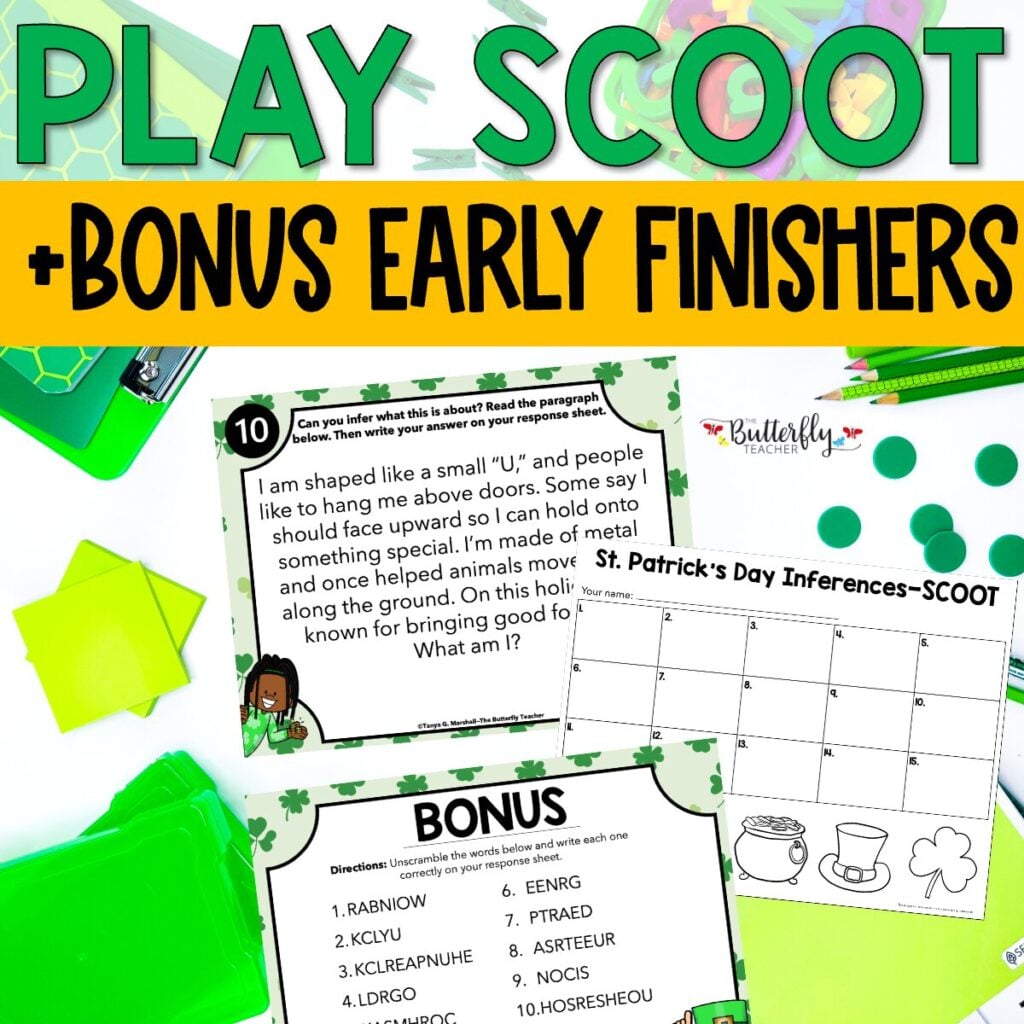
Click the image to see how these would work in your class.
The energy stays positive, and your students are practicing inference in a structured way.
You can also use these riddles in:
- Small guided reading groups
- Exit tickets
- Partner work with accountable talk
- Seasonal literacy stations
And if you’re reading fiction texts this month, it pairs nicely with lessons on character motivation and theme — since inference plays such a big role in both.
Are St. Patrick’s Day Activities in Upper Elementary Just for Fun?
Not at all.
When you plan intentionally, St. Patrick’s Day activities for upper elementary can reinforce:
- ✏️ Strong descriptive writing
- 🧠 Inference and critical thinking
- 💬 Text evidence and justification
- 📖 Reading comprehension strategies
- 🎨 Creative expression
March can feel long. Engagement dips. Testing prep starts looming.
Seasonal literacy activities give students something to look forward to — while still keeping your instruction focused and rigorous.
And that’s the sweet spot, teacher friends. ✨
Happy St. Patrick’s Day Teaching!! 🍀
