



If you’ve ever watched a 3rd grader eagerly “edit” their writing by changing random capital letters—or “fix” spelling when the sentence doesn’t even make sense—you’re not alone. I’ve been there, too. 🤦🏾♀️
Revising and editing are two skills we often lump together, but for students, they feel very different. And when those differences aren’t clear, kids end up fixing the wrong things, getting frustrated, or rushing through writing tasks without really improving their work.
In this post, I’m breaking down the 5 key differences between revising and editing practice in 3rd grade in a clear, teacher-friendly way. This is written for upper elementary teachers and homeschooling parents who want students to understand what they’re changing, why they’re changing it, and how to practice each skill effectively—without overwhelm.
This post may contain affiliate links to Amazon for your convenience. As an Amazon Associate, I earn from qualifying purchases, which do not cost any extra for you. Please see the full disclosure here.
Table of Contents
What Are the 5 Key Differences Between Revising and Editing Practice in 3rd Grade?
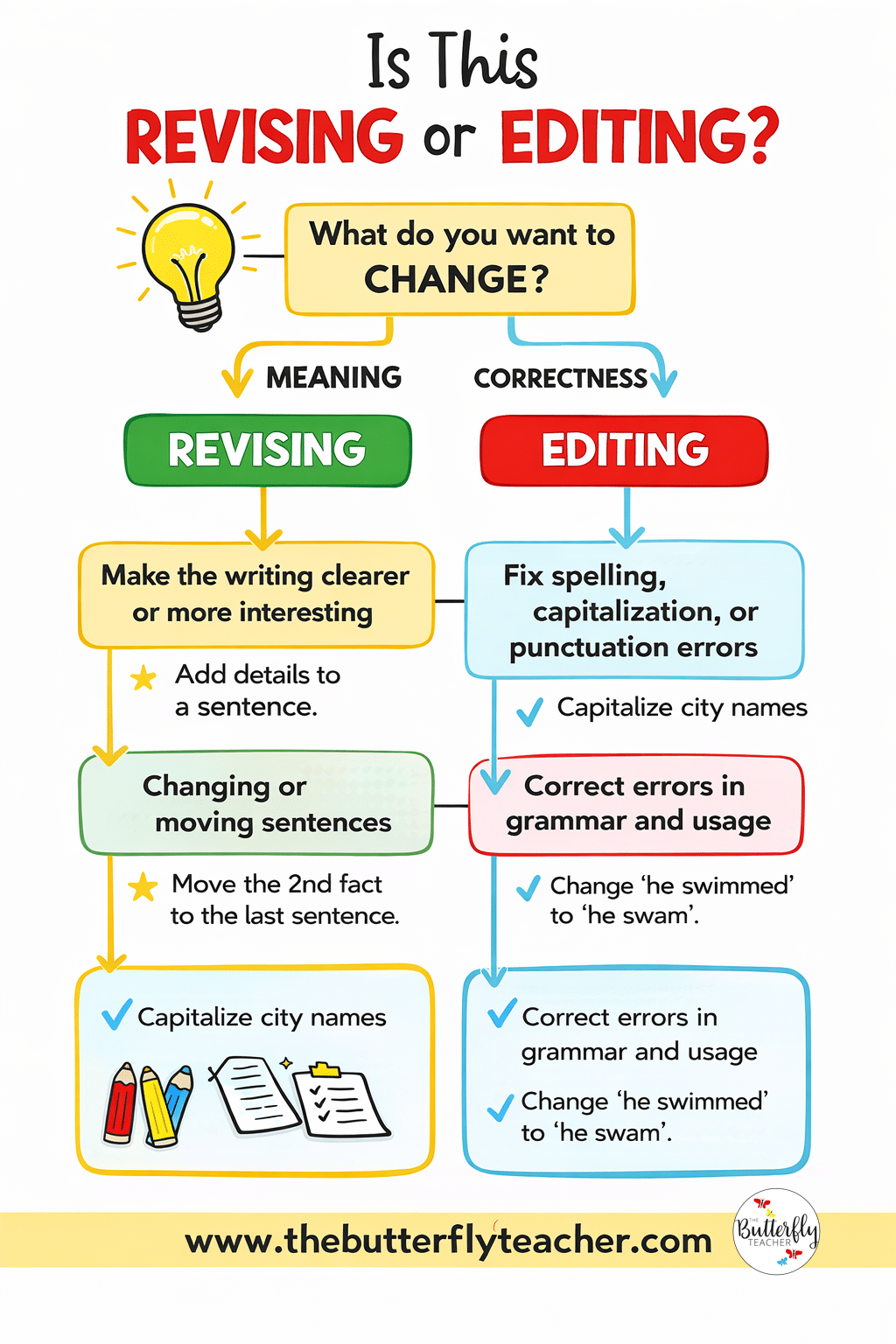
The biggest confusion around revising and editing comes from not seeing them side by side. Here’s a simple breakdown that makes the differences obvious—for teachers and students.
1: The Purpose
- Revising improves the meaning of the writing.
- Editing fixes the correctness of the writing.
Revising asks: Does this make sense to the reader?
Editing asks: Is this written correctly?
2: The Type of Changes Students Make
- Revising changes ideas, details, sentence clarity, or organization.
- Editing changes grammar, punctuation, capitalization, and spelling.

If students are adding details to different sentences or clarifying ideas, they’re revising. However, if they’re fixing commas or verb tense, they’re editing.
3: When Each Skill Happens
- Revising happens while ideas are still flexible.
- Editing happens after ideas are set.
In 3rd grade, over-editing often shuts down creativity. Revising first gives students permission to think and improve without worrying about being “right” with grammar.
4: The Type of Thinking Required
- Revising requires deeper, big-picture thinking.
- Editing requires attention to rules and patterns.
Both skills are important—but they stretch different parts of the brain.
5: How Students Are Best Supported
- Revising works best with guiding questions and prompts.
- Editing works best with checklists, routines, and clear expectations.
This is why proofreading practice is so powerful when it’s structured and consistent.

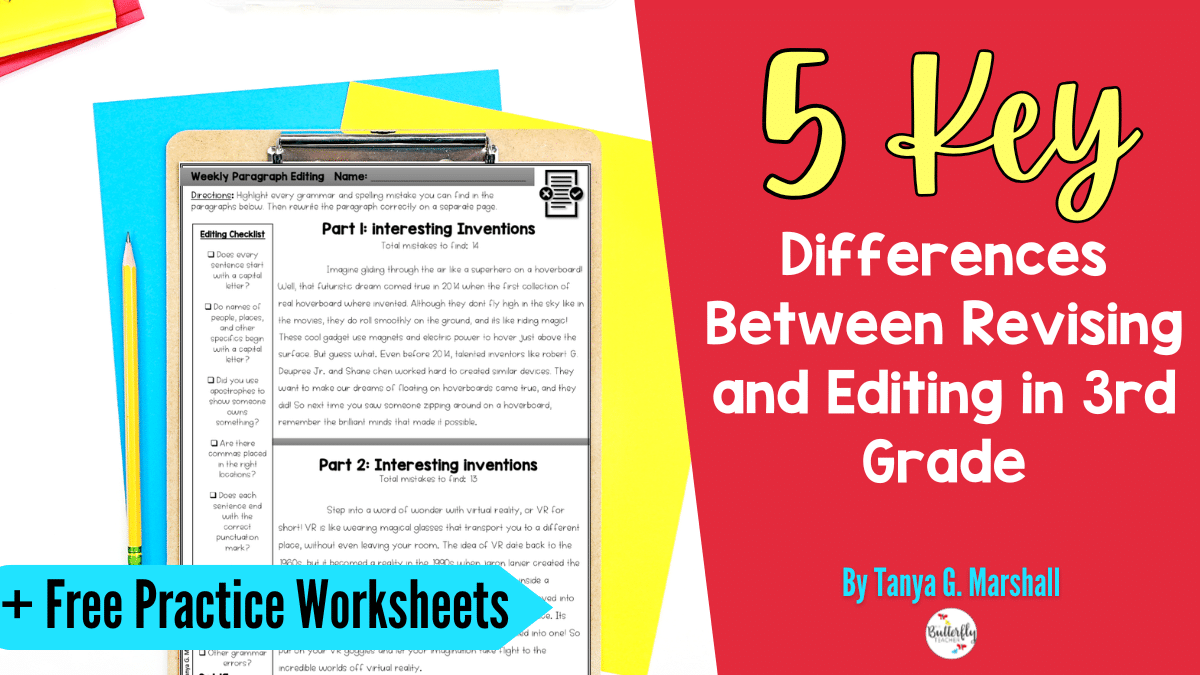
Do your students need more editing practice? This revising and editing practice in 3rd grade proofreading set offers targeted skill review perfect for your kiddos! Click the image to see more.
📊 Revising vs. Editing: Key Differences at a Glance
| Feature | Revising | Editing |
|---|---|---|
| Purpose | Improve meaning | Fix correctness |
| Changes Made | Ideas, clarity, details | Grammar, punctuation, spelling |
| Timing | During drafting | After ideas are set |
| Thinking Type | Big-picture thinking | Rule-based thinking |
| Student Support | Prompts & questions | Checklists & routines |
FAQs About Revising and Editing Practice in 3rd Grade
Is proofreading the same as editing in 3rd grade?
Proofreading is a form of editing. It focuses on finding and fixing errors in grammar, punctuation, capitalization, and spelling—not on changing ideas.
Should revising be taught before editing?
Yes–Research on effective writing instruction shows that students benefit from revising for meaning before editing for correctness, because revision improves ideas, clarity, and organization first, while editing is meant to polish finished writing. When students edit too early, they often fix surface-level errors without improving the quality of their writing.
Can students revise and edit at the same time?
They can, but separating the two skills helps 3rd graders understand what kind of change they’re making and why.
How can I help my 3rd graders improve their proofreading?
Use short, consistent proofreading routines and give students a clear checklist so they know exactly what to look for.
Practicing with short paragraphs like these helps students focus on one skill at a time instead of feeling overwhelmed. Over time, repeated exposure to common errors builds confidence and accuracy.
Why Do 3rd Graders Confuse Revising and Editing Practice?
Most students confuse revising and editing because they’re asked to do both at once—without clear expectations and guidance on the differences. When everything feels like “fixing,” kids default to the easiest changes they know, like spelling or capitalization.
Clear language, visuals, and consistent routines help students slow down and choose the right type of fix instead of guessing.

Click the image to see this Paragraph Proofreading set with editing checklists for 3rd graders.
Not only that, but when it comes to editing, 3rd graders thrive when they know how many grammar mistakes they are looking for + they have an editing checklist to guide them.
Which Standards Do Revising and Editing Practice Align to in 3rd Grade?
Revising and editing are supported by different types of academic standards, which is why they deserve different instructional approaches.
| Skill | Standards Focus | What Students Practice |
|---|---|---|
| Revising | Writing standards | Adding details, improving clarity |
| Editing | Language standards | Grammar, punctuation, spelling |
This separation explains why editing often needs more repeated, focused practice for students to feel confident.
Why a Clear Editing Scope and Sequence Makes Your Life Easier
Let’s be honest—grammar can start to feel like whack-a-mole if there’s no plan.
One week it’s commas, the next week it’s verbs, and suddenly you’re thinking, Wait… did we already cover this? Or am I just repeating myself?
This is where a clear, standards-based editing scope and sequence really helps you as the teacher.
A scope and sequence gives you a bird’s-eye view of which editing skills your students are practicing over time, so you’re not guessing or relying on memory.
You can quickly see what’s been introduced, what’s being revisited, and how skills are intentionally spiraled throughout the year.

Click the image to see the full editing standards + scope and sequence.
When editing practice is organized this way:
- You know exactly which skills students are building (and when)
- You can spot gaps or overlaps without digging through lesson plans
- Editing stops feeling random and starts feeling purposeful
And the best part? That consistency helps your students feel more confident. When they see the same editing skills show up again and again through spiraling—in different ways—it finally clicks so that proofreading isn’t a guessing game!
Why This Works (Without Adding More Work for You)
- Editing skills need repeated exposure, not one-and-done lessons
- A scope and sequence helps you teach with intention instead of scrambling
- Students benefit from predictable routines that reinforce the same skills over time
In other words, it helps you work smarter—not longer—while giving your students the steady practice they need to become stronger proofreaders.
How Do Revising and Editing Practice Show Up in 3rd Grade Classroom Assessments?
In most classrooms—and on many assessments—students aren’t told whether a question is asking them to revise or edit. They have to decide that themselves.
When students understand the difference between revising and editing, these questions stop feeling tricky and start feeling familiar.
Why Proofreading Practice Works So Well in 3rd Grade
Editing improves when students practice it often and with structure. Short, consistent proofreading routines help students:
- Notice patterns in errors
- Apply grammar rules more confidently
- Build independence over time
This is why weekly paragraph editing works so well—it strengthens editing skills without overwhelming students.
Try It with Free Revising and Editing Practice Worksheets
If you want students to start practicing the difference right away, I have free editing practice worksheets for 3rd grade you can try. They’re designed to support editing routines while keeping expectations clear and manageable.
Want to Explore Editing and Grammar Practice Even More?
If you’re building stronger routines with writing skills, these blog posts will help:
Both posts offer practical tips that support consistent, skill-based instruction without extra prep. Plus, you can find easy-to-implement ideas to use as a 3rd grade teacher.
Final Thoughts
Revising and editing are both essential—but they aren’t the same skill. When students understand the difference, they make better choices, feel more confident, and actually improve their writing.
Start small. Clarify expectations. And give each skill the kind of practice it needs.
That clarity makes all the difference. 🦋
