



How do you have effective editing practice for upper elementary in a way that actually sticks and helps them with their on-going writing?
If you’ve ever had students ace a grammar worksheet… then turn around and make the exact same mistake in their own writing … you are not alone.
Editing is one of those skills that sounds simple in theory but feels frustrating in real life.
In this post, I’m sharing what finally worked for me when teaching paragraph editing for 4th and 5th graders— and how I turned it into a simple weekly routine that builds real editing habits (without overwhelming your day).
And yes — you can still grab some FREE editing and proofreading worksheets to try this in your own classroom. 💛

This post contains affiliate links to Amazon for your convenience. As an Amazon Associate, I earn from qualifying purchases, which do not cost any extra for you. Please see the full disclosure here.
Table of Contents
The Main Problem with Editing Practice for Upper Elementary
Why do we even need to teach revising and editing so intentionally? Because every writer makes mistakes during the writing process.
Every. Single. One.
And our students? They’re still learning grammar rules. Of course they’re going to miss things.
But here’s the real issue I kept running into:
• My students learned a grammar skill with mentor sentences.
• They practiced it in isolation.
• They corrected sentences perfectly.
• Then… they repeated the same mistake in their own writing.
WHOO-HOO… YAY… UGHH.
I am not against mentor sentences. I love daily grammar practice. But isolated grammar practice does not automatically transfer into writing. That transfer has to be built.
And that’s where paragraph editing practice comes in.
That’s why I want to share effective ways to connect editing with writing. Not only that, but these ideas go beyond simple sentences with editing longer paragraphs.
Why Students Struggle to Apply Editing to Their Own Writing
After years of teaching 4th grade (after starting in 2nd grade), I realized students struggle with editing for a few predictable reasons:
- They don’t know what to look for.
- They treat editing like a guessing game.
- They only see grammar in single sentences.
- They don’t practice consistently.
- They never rewrite after correcting.
If editing feels random, students won’t build habits, and effective editing is a habit. Once I started treating it that way, everything changed.
Provide a Checklist of What Errors to Look For
Even though I adore using guessing games in the classroom, I don’t think they work for budding proofreaders.
For students who especially struggle with editing, having guidelines boost their confidence because they know what they are looking for.
So when I start teaching revising, I give my students a checklist of the types of errors they should correct.
We begin this process by focusing on paragraph correction worksheets before applying the checklist to their own paragraph writing.
This editing practice for upper elementary students works whether we are doing a whole group lesson or peer editing partner work.
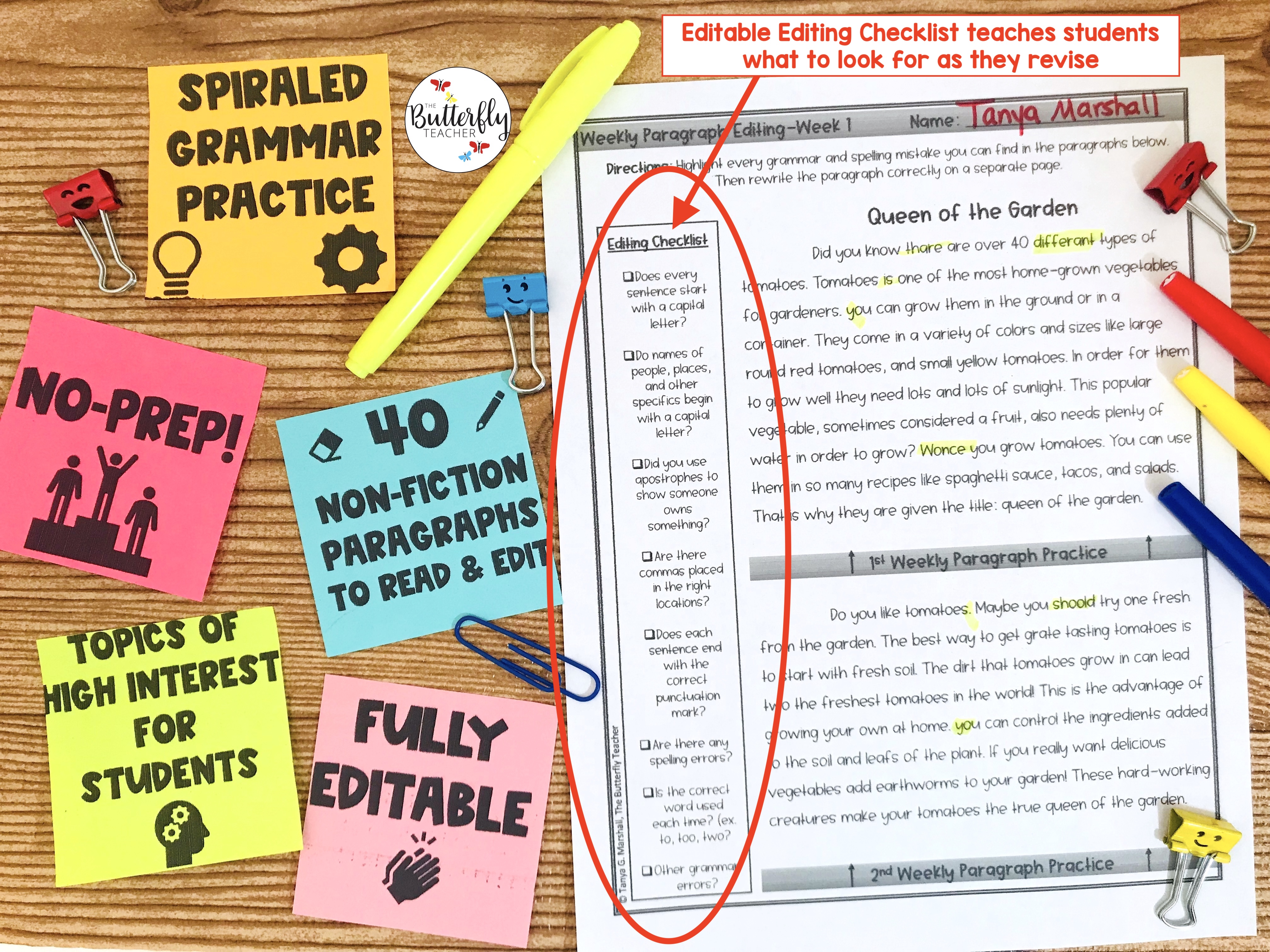
These editing checklists with each proofreading paragraph can be found in my full Paragraph Pro: Weekly Paragraph Editing System for 4th and 5th graders. Click the image to see them.
By using these editing checklists consistently, students build “proofreading habits” that become second nature when they are correcting their own writing later.
The one caveat I will give here is that you must MODEL for your students how to use the checklist correctly!
Don’t just assume that they will refer to it on their own the very first time.
For this activity, I love the “I Do, We Do, You Do” approach. It allows me to demonstrate the correct editing technique, then monitor their practice before allowing them to use it independently.
A Simple Weekly Paragraph Editing Routine That Builds Real Habits
Let me show you the structure that worked in my classroom. You can try this tomorrow; that’s how easy this is!
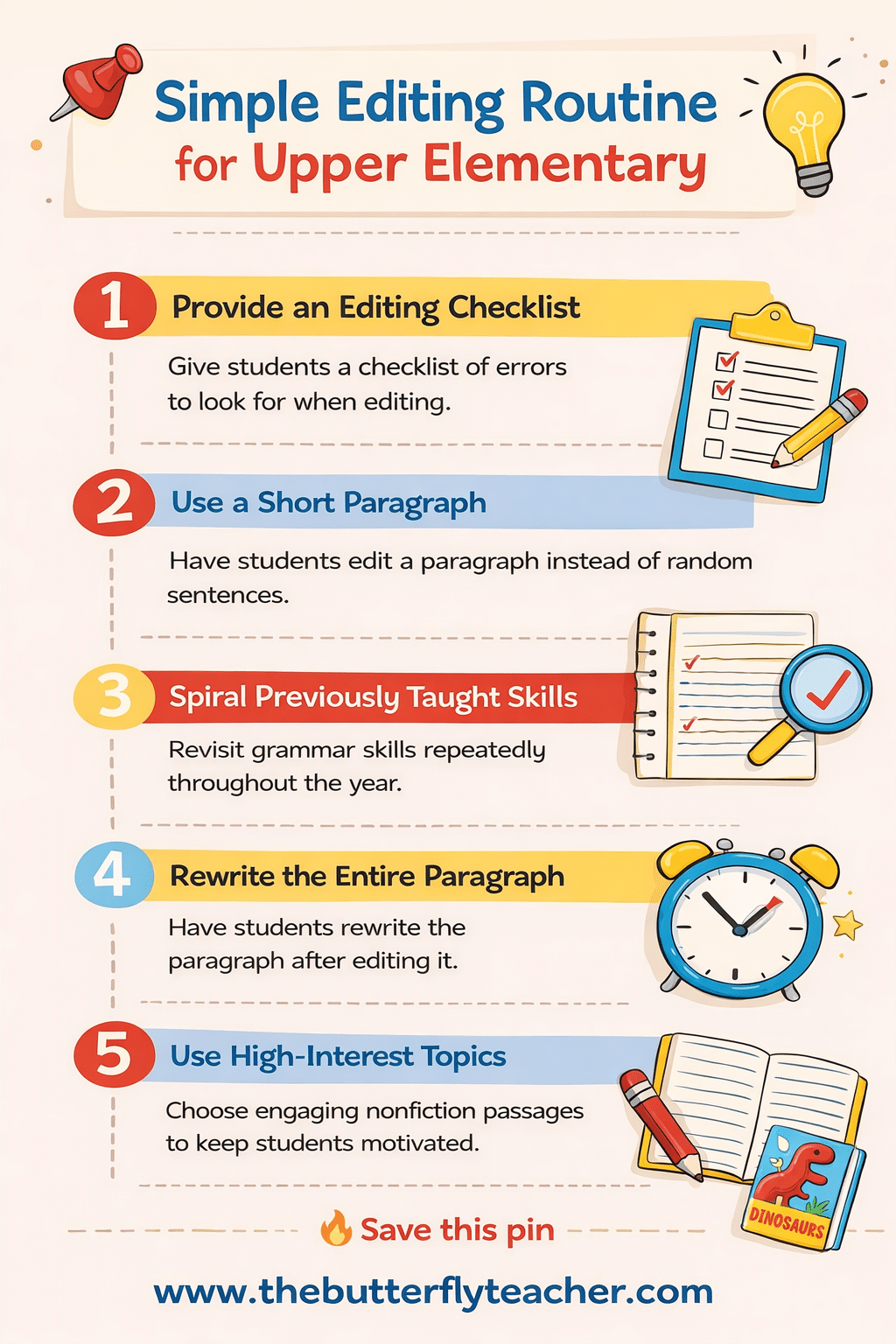
Step 1: Give Students a Clear Editing Checklist
Even though I love a good guessing game, guessing does NOT work for budding proofreaders. Students need to know what they’re looking for.
When I teach paragraph editing, I give students a checklist of specific errors to find:
- Capitalization
- Punctuation
- Subject-verb agreement
- Verb tense
- Spelling patterns
- Sentence structure
When they know the target, their confidence increases. And yes — you absolutely must model how to use it.
I use the classic “I Do, We Do, You Do” approach. First I demonstrate. Then we practice together. Finally, they try it independently.
Don’t assume they’ll naturally use the checklist correctly the first time. Modeling matters.
Step 2: Use Short Paragraphs (Not Just Random Sentences)
Editing isolated sentences is helpful — but real writing for upper elementary happens in paragraphs. When students edit a full paragraph:
- They see grammar in context.
- They practice reading comprehension.
- They build stamina.
- They notice patterns.
That context is what helps skills transfer into their own writing. Especially since my system requires my students to rewrite the full paragraph correctly once they correct all the mistakes. (more on this part below.)


Step 3: Spiral Grammar Skills Weekly
Instead of teaching one grammar unit and moving on forever…I spiral. Spiral review simply means students revisit grammar skills repeatedly throughout the year.
That repetition builds editing “muscle memory.” 💪🏽 In my classroom, we spent about 10–15 minutes a day on paragraph editing practice.
Short. Consistent. Powerful. Small habits → big results.
(Thank you, Atomic Habits. 😉)
Step 4: Have Students Rewrite the Entire Paragraph
Trust me, this is the game changer. After students correct the paragraph, they rewrite the entire corrected version. Yes, it takes extra time. ⏳
But it is SO worth it! Even for my kiddos who have a tendency to rush and make mistakes because of being careless, they will take a final look at their paragraph and see a mistake they made before turning it in.
That rewriting step forces them to connect editing with writing. Without rewriting, editing stays separate–like an isolated grammar lesson. With rewriting, it transfers., which eventually transfers to their own writing with other assignments.
Step 5: Use High-Interest Nonfiction Topics
Let’s be honest…if the paragraph is boring, students mentally check out. I choose engaging nonfiction topics so students are:
✔ Practicing grammar
✔ Building stronger close reading skills
✔ Learning something interesting
It becomes a win-win. And once they understand the routine, they can complete it independently while you teach a small group. 🙌
Consistently Include Revising Practice Activities
In the first section, I mentioned a little word that leads to big results: HABITS.
After reading Atomic Habits by James Clear, I started looking for ways to apply his theories about habit building in my teaching.
Instead of being overwhelmed by one big writing unit, I make time for smaller editing assignments each day or a few days a week during really busy weeks.
I started asking myself, “In what ways am I allowing editing practice for my students?”
This question led to a list of ideas that can be used for upper elementary students:
- weekly paragraph editing worksheets during literacy centers
- proofreading task card activities
- putting students in small groups to correct writing on anchor charts
- peer editing activities
- finding memes, Tweets, and other “grammar mistakes” on the internet to correct
This is not the full list, but they are some of my favorite examples that have worked over the years.
Give Spiraled Grammar Editing Practice
To piggyback off the previous section, I have found amazing results with my students when I spiraled my grammar lessons throughout the year, which is why I can’t say it enough.
When I spiral my grammar lessons, students complete weekly paragraph editing worksheets that revisit the revising skills we’ve already practiced.
Since they are combining this with editing checklists, they are getting proofreading effective practice every single week.
This video clip shows all of the academic standards that are covered in my 40-week grammar editing worksheet set which is available HERE in The Butterfly Teacher shop.
This is such an easy system and editing practice routine to implement because it works with ANY ELA curriculum.
Remember when I talked about building small habits?
This is why spiraling works wonders during editing practice for upper elementary students!
By consistently applying the same proofreading skills over time, students build stronger “editing muscles” when they revise their own writing.
Don’t Leave Out the FUN with Editing!
Editing doesn’t have to feel like boring punishment.
When students know the routine and the topics are engaging, they actually enjoy the challenge of finding mistakes.
It becomes a game. And that confidence carries over into their own writing. That’s the goal. 🏆
Frequently Asked Questions About Paragraph Editing in Upper Elementary
How often should 4th and 5th graders practice editing?
Short daily practice works best.
10–15 minutes a day builds stronger habits than one long weekly grammar block.
Consistency matters more than duration.
What’s the difference between revising and editing?
Revising focuses on ideas, clarity, and organization.
Editing focuses on grammar, punctuation, spelling, and conventions.
Both are important — but editing practice strengthens writing mechanics.
Do paragraph editing worksheets improve writing skills?
Yes — if students apply corrections.
That’s why rewriting the entire paragraph is so important. Without that step, skills may stay isolated.
With rewriting and spiral review, transfer increases.
Are paragraph editing activities good for test prep?
Absolutely.
Most upper elementary assessments include grammar questions within passages.
Paragraph editing helps students practice conventions in context while building reading stamina.
Can paragraph editing be used for digital or online learning?
Yes!
Digital versions allow students to highlight errors and rewrite paragraphs directly in Google Slides.
It works well for 1-to-1 classrooms and virtual settings.
To give you more insight into the types of topics I use, here’s a quick YouTube video that shows my Weekly Paragraph Editing Set with 40 weeks of spiraled revising and writing practice:
What All This Looks Like in Your Classroom
After creating new editing paragraphs week after week, I realized I needed something sustainable. So I created a 40-week Volume 1 spiraled paragraph editing system.
Each week includes:
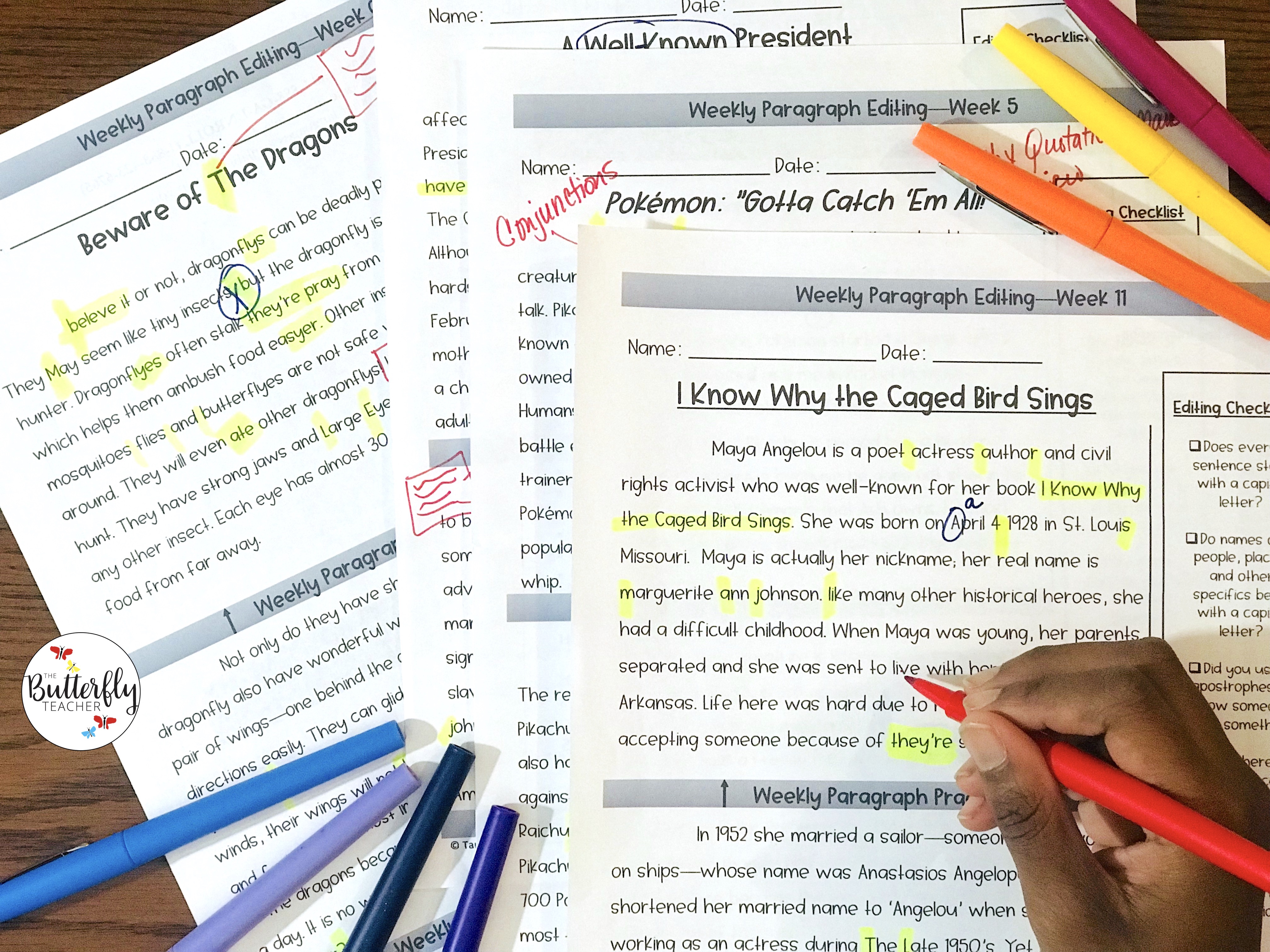
- A nonfiction paragraph with intentional grammar errors
- A built-in editing checklist
- Spiraled grammar skills
- Space to rewrite the corrected paragraph
- A printable version
- A Google Slides digital version


Click either image to see more details about these paragraph corrections resources. They work well together for proven effective editing practice for upper elementary.
It fits easily into:
- Morning work
- Literacy centers
- Small group rotations
- Homework
- Test prep review
I also designed easy-to-use and fully aligned assessments to pair with the practice edition. These quizzes make it easy to tell which grammar skills students truly understand with editing and which ones I still need to cover. (shown above)
If you love the structure I just described but don’t want to create new paragraphs every week, you can take a closer look at the full Paragraph Pro Weekly Paragraph Editing System set HERE.
Free Editing Worksheets for 4th and 5th Grade
If you want to try some editing / proofreading paragraphs, you can grab this FREE sample of this grammar editing resource ⬇️

Click the image to grab your freebie!
Want to Make Editing Easier This Year?
If you’re looking for a consistent grammar routine… with spiral review already built in… and you teach 4th or 5th grade and need no-prep editing practice…
You can explore the full Weekly Paragraph Editing practice + assessment sets for your class.
Or start with the free sample and see how it fits into your classroom first.
Either way, I hope this structure gives you a simple, sustainable way to strengthen editing skills in upper elementary.
Happy Teaching 💛
