


Ready to make vocabulary instruction more engaging and effective? This free vocabulary teacher training shares practical vocabulary teaching strategies that help upper elementary students understand, remember, and use new words.
You’ll learn simple ways to teach Tier 2 vocabulary, strengthen word knowledge, use visuals and word play, and build vocabulary through games, word parts, word walls, and literacy centers.
Perfect for teachers looking for effective upper elementary vocabulary instruction without adding complicated prep to their day.
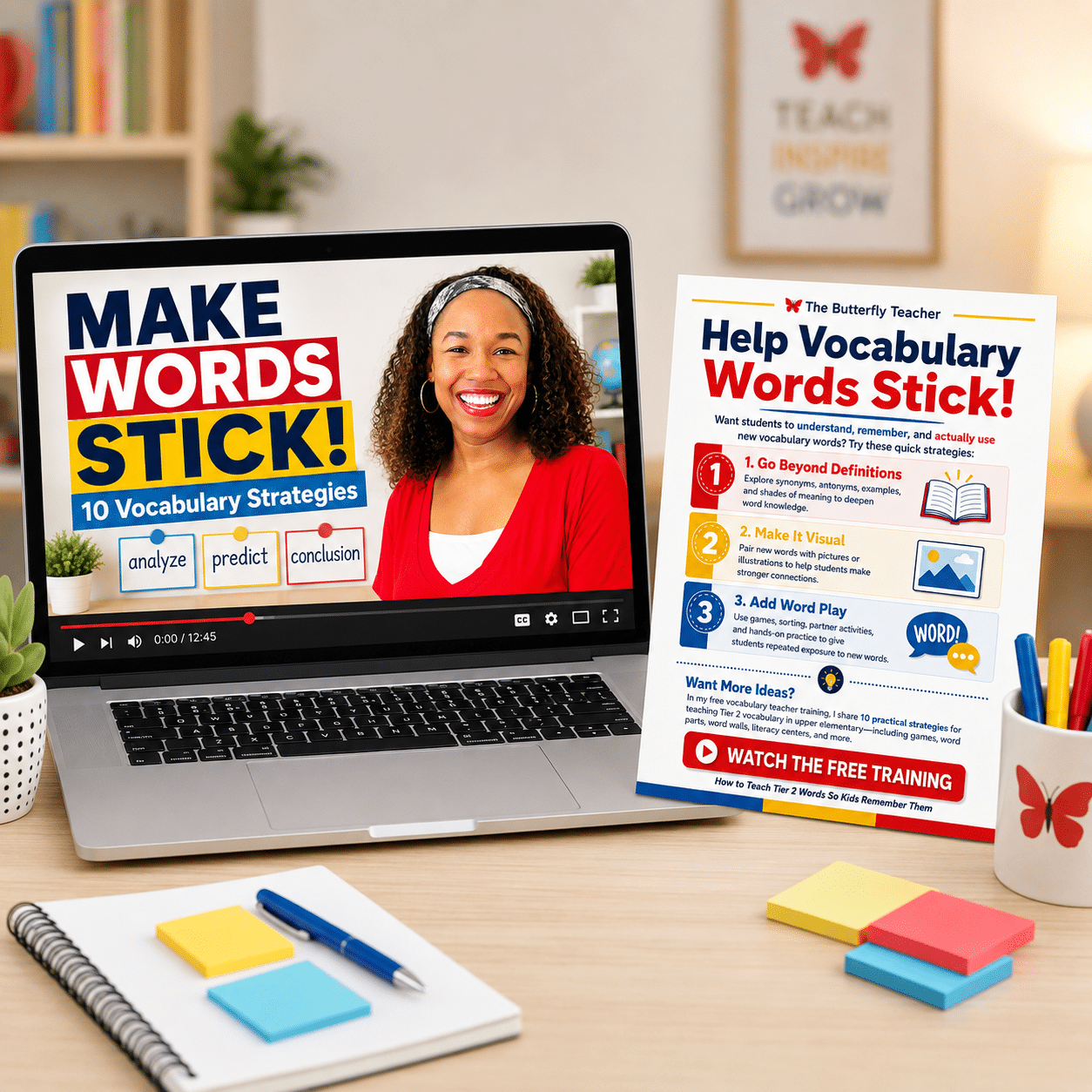
What’s Inside This Free Vocabulary Teacher Guide
Inside this free vocabulary teacher training for upper elementary teachers, you’ll get:
- 🎯 10 practical vocabulary teaching strategies you can use with Tier 2 words
- 🧠 Simple ways to help students remember new vocabulary instead of forgetting it after one lesson
- 🖼️ Visual vocabulary ideas that make new words easier to understand and connect to meaning
- 🎲 Games and word play activities for synonyms, antonyms, shades of meaning, and more
- 🔤 Word-part strategies for teaching prefixes, suffixes, and Greek and Latin roots
Each strategy gives you a practical way to make upper elementary vocabulary instruction more engaging, meaningful, and memorable—without adding complicated prep to your day.nning pages make it simple to visualize your rotations and customize them to fit your classroom needs.
⭐ Why Vocabulary Instruction Matters in Upper Elementary
Vocabulary instruction is about more than memorizing definitions. Strong word knowledge helps students understand what they read, explain their thinking, and make sense of academic language across subjects.
This free vocabulary teacher training shows you practical ways to:
- Help students remember new words instead of forgetting them after a quiz
- Teach Tier 2 vocabulary in ways that build deeper understanding
- Use games, visuals, word parts, and repeated practice to make vocabulary stick
- Strengthen reading comprehension through more meaningful vocabulary instruction
You’ll walk away with teacher-friendly strategies you can use during whole group lessons, literacy centers, small groups, and word work.
FAQs About Teaching Vocabulary in Upper Elementary
What are Tier 2 vocabulary words?
Tier 2 words are high-utility academic words students encounter across different texts and subjects. Words such as analyze, predict, and conclusion are good examples. They’re especially valuable because students can use them in more than one content area.
How many vocabulary words should I teach at one time?
There isn’t one perfect number for every classroom, but keeping the list manageable gives students more time to interact with each word. Many explicit vocabulary approaches focus on a small group of carefully selected words rather than a long weekly list.
How do I help students actually remember vocabulary words?
Repeated exposure matters. Students need opportunities to hear, say, read, write, visualize, and use new words in different contexts. Games, synonyms and antonyms, visuals, examples, and word-part activities can all deepen word knowledge.
How do I choose which vocabulary words to teach?
Prioritize words that are important for understanding the text or lesson and useful beyond one specific activity. Tier 2 words are often strong choices because they appear across subjects and support academic reading and discussion.
Should students just look vocabulary words up in the dictionary?
Dictionary definitions alone usually aren’t enough. Students benefit more from student-friendly definitions plus examples, visuals, discussion, and repeated opportunities to use the word themselves.
Pair This Guide with More Vocabulary Teaching Resources
Once you grab your free guide on how to teach Tier 2 vocabulary words, take your vocab instruction to the next level with this blog post and YouTube video:


The tips and ideas in this blog post and video pair perfectly with your free guide and give you practical examples to implement right away.